Dental Practice Managers: Audit First Playbook for Missed Calls
Audit calls for 30 days, set a 60 minute callback SLA, add HIPAA compliant automation to stop missed dental calls. KPIs and checklist.
How many customers are slipping away before you can answer?
Answer 4 quick questions and get a simple missed-call estimate for your business.
Answer with one tap. Contact details come after your result.
Here is the estimate.
Thanks. Your result was received.
Track your missed-call rate this week, follow up with every missed caller within 60 minutes, and put reliable fallback coverage in place, whether that's a human on-call or automation, so you stop losing patients to a ringing phone. The American Dental Association flags this as a fixable operations problem, not a staffing mystery. Tools like missed-call text back, appointment reminders, and an AI receptionist such as RingPort make the fix practical.
TL;DR:
- Tracking and returning missed calls within 60 minutes can significantly reduce patient loss and improve conversion rates.
- Implementing operational, procedural, and technology fixes like call audits, scripted callbacks, and missed-call texts can lower missed-call rates below 20%.
- Automation tools such as AI receptionists and appointment reminder texts extend coverage outside business hours and cut no-shows effectively.
- Ensuring compliance requires signed vendor agreements and limiting automated messages to administrative details under HIPAA.
- Measuring key performance indicators weekly, especially missed-call rates and callback times, proves whether the process fixes are successful.
Table of Contents
- Impact: how much missed calls actually cost your practice
- Common causes: why dental offices miss calls
- Quick operational fixes you can implement this week
- Technology options that actually reduce missed calls (and compliance caveats)
- How to measure progress: KPIs, tests, and a simple dashboard
- Practical examples and author perspective
- The playbook works only if you fix the process before the technology
- How RingPort helps reduce missed calls
- FAQ
- Sources
Impact: how much missed calls actually cost your practice
Phone calls that go unanswered are not a minor inconvenience. Some practices lose as many as 30% to 50% of initial prospective patient contacts to poor phone handling, according to the American Dental Association, and the ADA considers a loss rate above 20% a clear signal that call management needs attention.
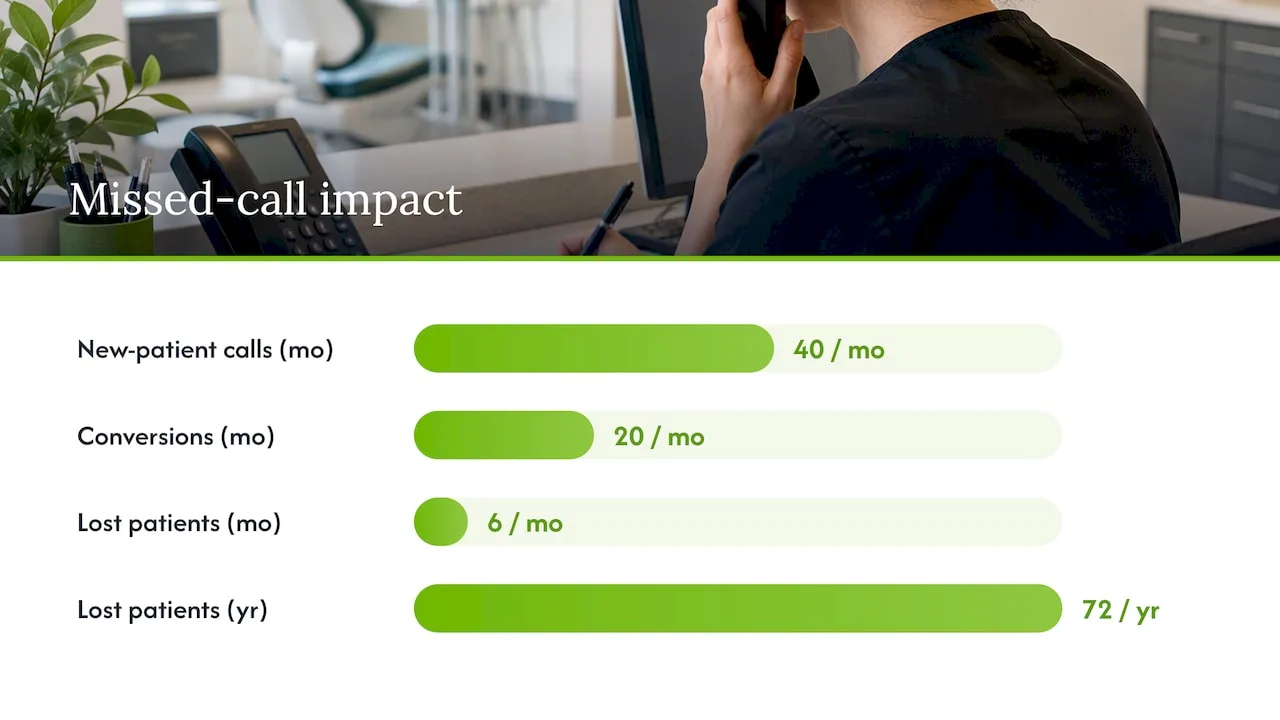
Run the math on a typical practice fielding 40 new-patient calls a month. If even half convert to a first appointment with a reasonable case value, that is six lost patients every month, compounding over a year into a meaningful gap in production.
The damage spreads beyond the missed booking itself. Callers who hit voicemail during business hours often assume the practice is unresponsive and call a competitor next. Some leave frustrated reviews. Marketing spend aimed at driving new-patient calls gets wasted the moment those calls go unanswered, since the acquisition cost was already paid before the phone ever rang.
Common causes: why dental offices miss calls
Most missed calls trace back to one of three categories, and the fix depends on diagnosing the right one.
- Operational strain: front-desk staff are mid-checkout or chairside during peak hours, so incoming calls stack up with nobody free to answer.
- Technology gaps: no overflow line, no missed-call capture, and scheduling software that does not talk to the phone system, so a dropped call simply disappears.
- Procedural gaps: no consistent script for callers, no owner assigned to missed-call follow-up, and no service-level agreement for how fast a callback should happen.
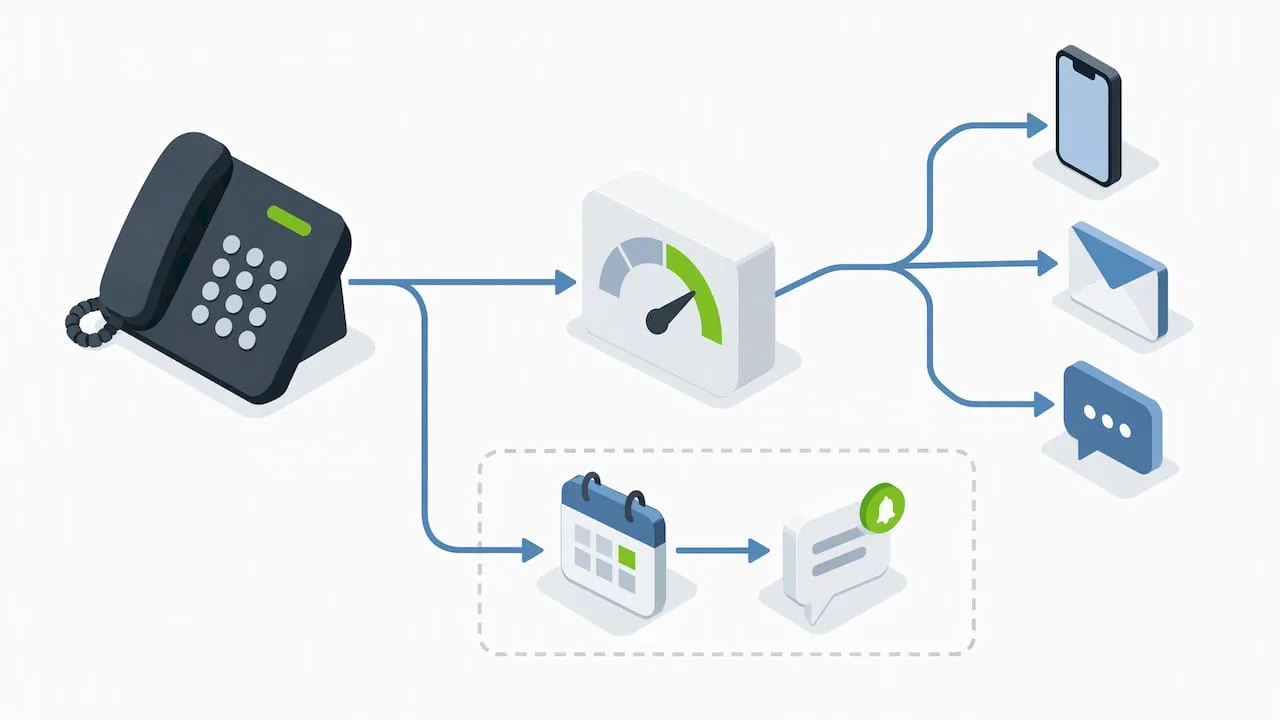
Smart call routing addresses the technology piece directly by sending overflow calls to a backup line instead of a busy signal, but routing alone will not fix a front desk that has no process for calling people back.
Quick operational fixes you can implement this week
You do not need new software to start closing the gap. These changes take a few hours to set up and start paying off almost immediately.
- Run a 30-day lost-call audit. Compare new-patient calls against scheduled new-patient visits to find your true miss rate before you change anything.
- Rewrite your voicemail and on-hold script. Keep it short, state your hours, and give callers a reason to expect a fast callback or text.
- Set a 60-minute callback SLA. Every missed call gets a return call or a missed-call text within an hour, no exceptions.
- Designate an overflow role. Cross-train one team member to pick up calls during lunch and breaks, and stagger shift breaks so the phone is never unattended.
Pro Tip: Keep your missed-call text under two sentences: acknowledge the missed call, give a booking link, and sign it with your practice name so it reads as a real message, not spam.
Technology options that actually reduce missed calls (and compliance caveats)
Once the process fixes are in place, technology closes the remaining gap, especially outside business hours.
- Auto-attendant and IVR: route callers to the right department but do not capture a lead if nobody answers.
- Missed-call text-back: automatically texts a caller the moment a call goes unanswered, turning a dropped call into a conversation.
- Appointment reminder texts: cut no-shows and free up staff time otherwise spent on manual reminder calls, detailed further in our guide to reminder texts.
- AI receptionist or virtual agent: answers around the clock, books appointments directly, and hands off to a human when a call needs judgment.
Each category covers a different gap. An auto-attendant helps during business hours; an AI receptionist extends coverage to evenings and weekends when most practices have nobody at the desk.
Compliance matters here. HHS guidance confirms that appointment reminders count as treatment-related communication and can be sent without patient authorization under HIPAA, as long as automated messages stick to administrative details like date and time rather than diagnosis or treatment specifics. Separate HHS guidance on telehealth confirms that covered entities may use VoIP and messaging tools for patient communication, provided vendor agreements and configurations protect patient information appropriately.
Before signing with any vendor, confirm: a signed Business Associate Agreement if the system stores patient data, integration with your practice management software, visible reporting, a test mode before go-live, and a clear path to escalate a call to a human. Our breakdown of HIPAA-compliant texting and this HIPAA roadmap for conversational AI both walk through the contractual details worth checking before you commit.
How to measure progress: KPIs, tests, and a simple dashboard
Fixes only matter if you can prove they worked. Track a short list of numbers weekly rather than guessing at improvement.
- Missed-call rate: unanswered calls divided by total inbound calls, your core measure.
- New-patient call-to-book conversion: how many new-patient calls actually turn into a scheduled visit.
- Average callback time: how long missed callers wait before hearing back from your team.
- First-call resolution: the share of calls that get booked or resolved without a second contact.
Pilot one variable at a time: try automated coverage during two evening hours and one weekend block, then compare conversion against your staffed hours. Pull the numbers from your phone logs and scheduling export into a simple weekly sheet, and expect your missed-call rate to drop noticeably within the first 30 to 90 days if the fixes are working.
Practical examples and author perspective
The practices that cut missed calls fastest treat it as a pilot, not a rollout: test one channel, measure it for a month, then expand. Missed-call text back and appointment reminders tend to fit cleanly into existing staff workflows because they handle the repetitive part of the job, the acknowledgment and the reminder, while the front desk keeps the judgment calls. The guardrail that matters most: keep automated messages limited to administrative details, and sign a Business Associate Agreement whenever a vendor stores or processes patient information.
The playbook works only if you fix the process before the technology
Most advice on this topic leads with software, and that order is backwards. A fast AI receptionist bolted onto a front desk with no callback discipline just answers the phone faster, it does not fix the missing follow-up that lets a captured lead slip away. The audit step gets skipped the most often, yet it is the cheapest and most revealing: measuring your actual miss rate for 30 days tells you whether the problem is staffing, hours, or scripting, long before you spend money on a fix.
Prioritize the callback SLA first. A one-hour rule costs nothing to implement and catches most of the lost patients that a slow or inconsistent front desk would otherwise miss. Automation earns its place second, as the layer that catches what a busy or closed front desk cannot.
— Serhii
How RingPort helps reduce missed calls
We built RingPort as an AI receptionist for local service businesses, including dental offices, that need calls answered and appointments booked without adding a full-time staff member. Every capability in this playbook maps directly to a feature we run around the clock.
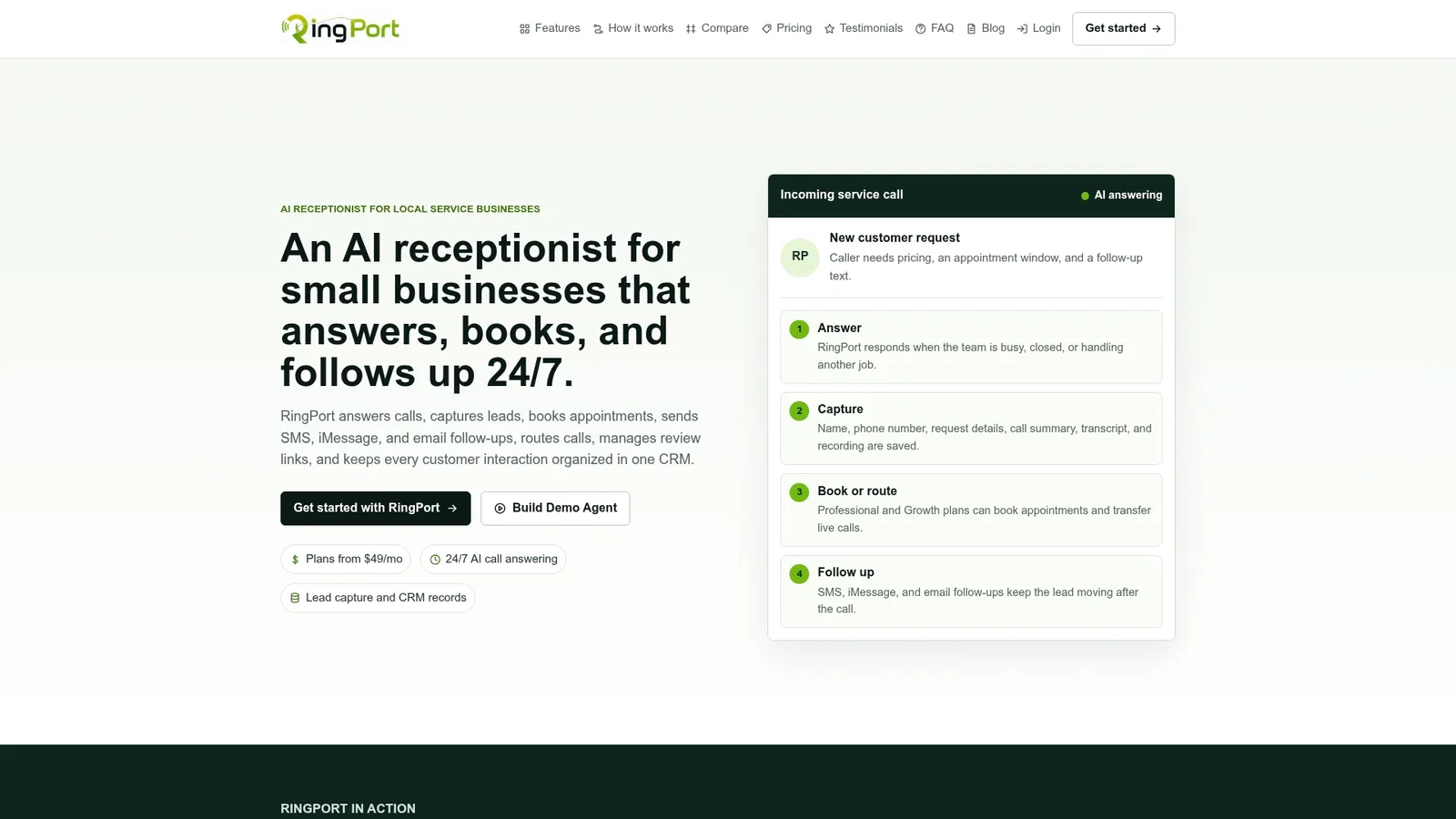
- 24/7 AI call answering picks up when your front desk cannot, so evening and weekend callers reach someone instead of voicemail.
- Missed-call text back fires automatically the moment a call goes unanswered, so no lead goes cold.
- Appointment reminder texts cut down on no-shows without pulling staff away from the desk.
- Smart routing and CRM capture keep every call, booking, and follow-up organized in one place.
If you want to test this before committing to a full rollout, pick one location or provider, enable missed-call text back, and track your KPIs for 30 days. For practices ready to see rapid-response automation in action, our Fast Agent feature is worth a look, and you can explore plans starting at $49 per month on the RingPort site whenever you are ready to evaluate.
FAQ
What is the 80/20 rule in dentistry?
The rule in dentistry generally refers to the idea that a large share of production or patient value tends to come from a smaller core group of patients, so practices focus retention efforts there. Definitions vary across practices, but the underlying principle is prioritizing the relationships that drive the most consistent return.
Can you call off work for a dental appointment?
Whether you can take time off work for a dental appointment depends on your employer's policies and local labor rules rather than any dental-specific regulation. Most employers allow personal or sick time for medical and dental visits, so check your workplace policy or HR department for specifics.
What can I do if I'm too embarrassed to see the dentist?
Dental anxiety and embarrassment about oral health are common, and most dental teams are trained to handle these concerns without judgment. Calling ahead to explain your concerns, or asking about a private initial consultation, can make the first visit easier.
What is the dental code for a missed appointment?
There is no single universal billing code for a missed dental appointment, since policies on charging for no-shows vary by practice and by state regulation. Practices typically document missed appointments internally and apply their own no-show fee policy rather than submitting a standardized code to insurance.
Sources
- Inquiries from Prospective Patients | American Dental Association
- Hhs
- HHS guidance on telehealth and HIPAA