Is HIPAA-Compliant Texting Possible for Your Practice?
Discover how to ensure your practice can text securely while staying HIPAA-compliant. Learn the essential steps and safeguards to protect patient information.

How many customers are slipping away before you can answer?
Answer 4 quick questions and get a simple missed-call estimate for your business.
Answer with one tap. Contact details come after your result.
Here is the estimate.
Thanks. Your result was received.
Yes, texting can be HIPAA compliant, but only when specific safeguards are locked in first: a signed Business Associate Agreement (BAA) with your messaging vendor, encryption in transit and at rest, audit logging, strong authentication, mobile device management (MDM), and documented patient consent. Skip any one of these, and you're not texting, you're exposing your practice.
Standard text messaging (SMS) does not meet these requirements on its own. Neither does a personal iPhone with iMessage turned on, no matter how secure Apple's marketing makes it sound. What actually satisfies the HIPAA Security Rule is a purpose-built secure texting platform, backed by a contract, and wrapped in written policy.
Before you send another text containing patient information, take these three steps:
- Stop texting PHI on standard SMS or consumer apps immediately until you've confirmed your platform has a signed BAA.
- Start a vendor due-diligence checklist covering encryption specs, audit log exports, and SOC 2 documentation.
- Run a texting-specific risk analysis that identifies exactly where protected health information (PHI) travels through your messaging workflow today.
Pro Tip: If you're not sure whether your current texting habits qualify as a HIPAA violation, ask yourself one question: could a stranger who intercepted this message identify a patient and learn something about their health? If yes, you need a compliant platform, not a New Year's resolution to "be more careful."
The HHS Office for Civil Rights has made clear that HIPAA doesn't ban electronic communication outright. It requires covered entities to apply the Privacy and Security Rules, which means reasonable safeguards, documented risk analysis, and patient consent where texting is used for anything beyond the most basic administrative content.
Key Takeaways
HIPAA-compliant texting requires a signed BAA, encryption in transit and at rest, audit logging, MDM, and documented consent working together, not any single feature in isolation.
| Point | Details |
|---|---|
| BAA comes first | Never send PHI through a texting platform until a signed Business Associate Agreement is in place. |
| Encryption must be specific | Confirm TLS 1.3 in transit and AES-256 at rest; vague "secure" claims aren't verification. |
| Audit logs prove compliance | Retain exportable, immutable logs with user ID and timestamps for at least six years. |
| Keep clinical content off SMS | Use secure portal links for diagnoses, doses, or images; reserve texts for logistics. |
| Consider managed intake workflows | Ringport centralizes call answering, consent logging, and follow-up routing to reduce ad hoc PHI texting from personal phones. |
Table of Contents
- When Does Texting Become a HIPAA Compliance Issue?
- Why Standard SMS and Consumer Apps Fall Short on PHI
- What Safeguards Make Texting Actually HIPAA Compliant?
- How Do You Roll Out Compliant Texting Step by Step?
- What Can You Actually Text a Patient?
- What Happens If a Texting Incident Occurs?
- What Should You Ask a HIPAA Texting Vendor Before Signing?
- Which Controls Should You Prioritize First?
- Is There an Alternative to Direct PHI Texting Altogether?
- Frequently Asked Questions
- Sources
When Does Texting Become a HIPAA Compliance Issue?
Texting crosses into HIPAA territory the moment a message combines an identifier with health information. That's the legal trigger, and it's narrower than most staff assume, but also easier to hit than most staff realize.
Protected health information under HIPAA means any data that identifies a patient (name, phone number, date of birth, medical record number) tied to information about their health condition, treatment, or payment. A text that says "Your appointment is tomorrow at 2pm" to an unnamed number is generally low risk. A text that says "Hi Maria, don't forget your insulin dose before your 2pm appointment with Dr. Reyes" is unquestionably PHI, because it names the patient, names the condition, and identifies the provider.
Here's where it gets tricky for front-office staff who don't think of themselves as handling "medical records":
- A confirmation text with a patient's name and the name of a specialty clinic (say, an oncology or behavioral health practice) can reveal a diagnosis by implication.
- A text forwarding a photo of a rash, wound, or lab printout is PHI even without a name attached, if it can reasonably be linked back to a specific patient.
- Group texts or texts sent to a family member's phone about a patient's condition typically require documented authorization first.
Not every organization touching this content has the same legal obligations. Covered entities are health plans, healthcare clearinghouses, and providers who transmit health information electronically for standard transactions, meaning most clinics, hospitals, dental offices, and behavioral health practices. Business associates are vendors and contractors who create, receive, maintain, or transmit PHI on a covered entity's behalf, which includes your texting platform, your answering service, and often your billing company.
The HIPAA Security Rule sets the actual bar: covered entities and business associates must ensure the confidentiality, integrity, and availability of electronic PHI. That three-part standard, confidentiality, integrity, availability, is what every safeguard downstream exists to satisfy. If your texting workflow can't guarantee all three, it doesn't matter how convenient the app is.
A useful gut check: if you wouldn't want the message read aloud in your waiting room, it's PHI, and it needs a compliant channel.
Why Standard SMS and Consumer Apps Fall Short on PHI
Regular SMS was never built with healthcare privacy in mind, and its architecture makes that obvious once you look under the hood. Text messages route through carrier networks, get stored on carrier servers and often on both sender and recipient devices in plaintext, and pass through intermediary systems that your practice has no contractual visibility into. Wireless carriers don't sign BAAs. There's no audit log you can pull for an OCR investigation, no remote wipe if a phone is lost, and no way to prove who actually read the message.
That combination, carrier storage, plaintext transit, and zero contractual accountability, is why industry guidance consistently treats standard SMS/MMS as structurally incompatible with HIPAA unless it's layered under a secure platform that intercepts the content before it ever touches the carrier network.
Apple's iMessage complicates this picture rather than solving it. Messages between two iPhones use end-to-end encryption, which sounds like it should clear the bar. But encryption alone isn't compliance:
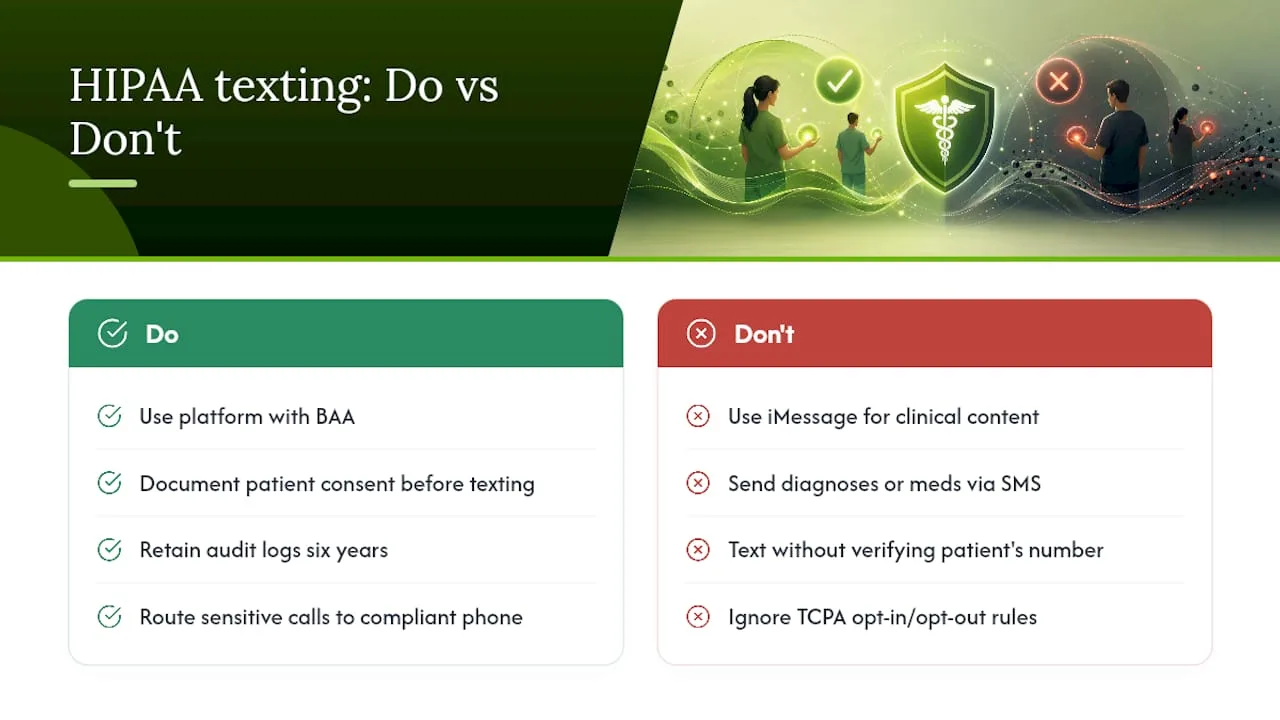
- Apple does not sign BAAs, so there's no contractual accountability if something goes wrong.
- There's no built-in audit trail your compliance officer can export for a HIPAA audit.
- The moment an iPhone user texts an Android user, iMessage silently falls back to unencrypted SMS or MMS, often without either party noticing the green bubble switch.
- iCloud backups can store message content off-device in ways your practice doesn't control or monitor.
That fallback behavior is the trap. A staff member might reasonably believe their iMessage conversations are secure, not realizing that half their patient population uses Android phones, meaning every one of those threads has been traveling as plaintext SMS the entire time. A peer-reviewed review of secure clinical messaging practices identifies encryption, auditability, and governance as the three pillars any clinical texting solution needs, and consumer apps typically deliver at most one of the three.
What Safeguards Make Texting Actually HIPAA Compliant?
Every vendor claims to be "HIPAA compliant." Your job is to verify which specific controls back up that claim, because the phrase itself has no legal enforcement mechanism behind it. Here's what to check, in the order that matters most during a vendor evaluation:
- A signed Business Associate Agreement. This is non-negotiable and the single most common compliance gap. The BAA should specify the vendor's obligations for breach notification timelines, permitted uses of PHI, subcontractor (subprocessor) disclosure, and data return or destruction upon contract termination. If a sales rep hesitates when you ask for a BAA, that's your answer.
- Encryption in transit and at rest. Industry best practice calls for TLS 1.3 for data moving between devices and servers, and AES-256 for data stored on servers or devices. Ask the vendor to name their encryption standard specifically; "we're encrypted" without a protocol name is a marketing sentence, not a technical answer.
- Authentication and access control. Each staff member needs a unique login ID, ideally paired with multi-factor authentication (MFA), and role-based permissions so a front-desk scheduler can't pull up a therapist's clinical notes thread.
- Audit logs and retention. Logs need to capture who accessed what message, when, and what action they took (read, forwarded, deleted). Most compliance programs retain these logs for a minimum of six years, matching general HIPAA documentation retention expectations.
- Endpoint protections through MDM. Mobile device management should support remote wipe if a phone is lost or an employee is terminated, the ability to disable local or cloud backups of message content, and enforced OS and app updates.
- Configurable message controls. Look for adjustable retention periods, message expiration settings, and workflow prompts that nudge staff toward "minimum necessary" language rather than full clinical detail.
Pro Tip: During a vendor demo, ask them to walk through exporting an audit log for a single patient thread in real time. If they can't do it on the call, they probably can't do it during an actual OCR investigation either.
These controls collectively satisfy the administrative and technical safeguards required under 45 CFR § 164.308, which spells out risk analysis, risk management, and workforce training as foundational obligations, not optional extras layered on top of a texting app.
How Do You Roll Out Compliant Texting Step by Step?
Compliance officers rarely fail because they didn't know the rules. They fail because implementation stalled somewhere between "we should fix this" and an actual signed contract. Here's a sequence that avoids that trap.
- Run a texting-specific risk analysis. Don't fold this into your annual general risk assessment as an afterthought. Map every point where PHI currently moves through text messages, personal phones, front-desk tablets, on-call physician devices, and document the gaps in writing.
- Update your written policies. Cover acceptable use, minimum necessary standards for message content, patient consent capture, and bring-your-own-device (BYOD) rules for staff using personal phones.
- Conduct vendor due diligence. Request the BAA draft, SOC 2 Type II report, a summary of the most recent penetration test, and a sample audit log export before signing anything.
- Handle technical deployment and integration. Confirm the platform integrates with your EHR where relevant, supports single sign-on (SSO), and enforces the authentication requirements from your policy, not just the vendor's default settings.
- Train staff and monitor ongoing use. Consent capture needs a documented, repeatable process, not a verbal "is it okay if we text you?" Schedule periodic reviews, quarterly is common, to confirm the platform is actually being used as intended.
A few practical notes that tend to get skipped:
- Assign a single named owner for the texting program; shared ownership usually means no ownership.
- Build consent language into your intake paperwork so it's captured at the first patient touchpoint, not retrofitted later.
- Revisit your BYOD policy separately from your platform policy. A compliant app on a personal, unmanaged phone still creates exposure if MDM isn't enforced on that device.
The HHS Security Rule guidance expects this due diligence to be documented, not just performed. If your compliance file doesn't show the paper trail, an auditor will treat the safeguard as if it never happened.
What Can You Actually Text a Patient?
The safest rule of thumb: text logistics, not clinical content. Appointment reminders, check-in prompts, and requests to call the office are almost always fine. Anything describing a diagnosis, medication dose, lab result, or clinical image belongs behind a secure portal link, not in the message body itself.
Safe examples that stay within minimum necessary standards:
- "Hi, this is a reminder for your appointment on Thursday at 10am with Dr. Patel. Reply C to confirm."
- "Your test results are ready. Please log in to your patient portal to view them: [secure link]."
- "We're running about 15 minutes behind today. Thanks for your patience."
- "Please complete your intake forms before your visit: [secure link]."
Unsafe examples that should never leave a secure clinical channel:
- "Your A1C came back at 9.2, we need to adjust your metformin dose to 1000mg twice daily."
- A photo of a wound, rash, or imaging result sent directly through text, even with good intentions.
- "Following up on your anxiety medication, how are the side effects from the increased dose?"
The pattern is consistent: if the message names a condition, a drug, a dose, or includes an image, route it through a secure link instead of typing it into the message body. Secure links let you deliver detailed clinical information through an authenticated portal while the text itself stays generic enough to pose no PHI risk if intercepted.
Consent and phone verification matter here too. Capture written or electronic consent before texting starts, specify what types of messages the patient agrees to receive, and confirm the phone number belongs to the patient (not a shared family line) before sending anything beyond a basic appointment confirmation.
What Happens If a Texting Incident Occurs?
Your audit logs are your first line of defense when something goes wrong, and they need to capture enough detail to reconstruct exactly what happened. At minimum, logs should record user ID, message timestamps, delivery and read receipts, and a full export capability for regulators or legal counsel. Most compliance programs retain these records for at least six years to align with general HIPAA documentation standards.
When an incident does occur, whether it's a lost phone, a misdirected text, or a platform vulnerability, speed and documentation both matter:
- Contain the exposure immediately. Revoke device access through MDM, disable the affected account, or pull the message thread if the platform allows it.
- Run a risk assessment on the specific incident, evaluating the nature of the PHI involved, who received it, and whether it was actually viewed or just delivered.
- Determine notification thresholds. Breaches affecting 500 or more individuals require notification to HHS OCR, affected patients, and in many cases local media, generally within 60 days. Smaller breaches still require notification to affected patients and an annual log submitted to OCR.
- Check state-specific reporting triggers, since several states impose stricter or faster notification requirements than the federal floor.
Document every remediation step in writing: what was contained, when, who was notified, and what policy or technical change followed. Auditors and regulators evaluate your response based on the paper trail, not your intentions. A well-documented incident, even a real one, often reflects better on a compliance program than a suspiciously clean record with no evidence of monitoring at all.
What Should You Ask a HIPAA Texting Vendor Before Signing?
Vendor demos are built to impress, not to withstand scrutiny. Bring this checklist and don't move forward until every item gets a specific, verifiable answer.
- Will you sign a Business Associate Agreement before any PHI touches your platform? Get this in writing before the sales conversation goes any further.
- What are your exact encryption specifications? Ask for the protocol name (TLS version, AES key length), not a general assurance of "bank-level security."
- Can you export a complete, immutable audit log on demand? Ask to see this happen live, not described in a slide deck.
- Does your platform support MDM features like remote wipe and backup restrictions? Confirm this works across both iOS and Android, not just one ecosystem.
- Who are your subprocessors, and do they also have BAAs in place? A vendor that can't name their subprocessors is a vendor you can't actually audit.
- Do you have a current SOC 2 Type II report and a recent penetration test summary? Request both documents directly rather than accepting a compliance badge on their website as proof.
- What's your breach notification SLA? Get a specific number of hours or days written into the contract, not a vague "promptly" commitment.
Pro Tip: Treat vague answers as red flags, not oversights. A vendor that says "we're fully HIPAA compliant" without naming a BAA, an encryption standard, or an audit process is describing a marketing position, not a technical one.
Escalate to legal or compliance leadership immediately if a vendor refuses a BAA, can't describe their logging architecture in specific terms, won't name their subprocessors, or positions their product primarily as a consumer messaging app with healthcare as an afterthought. Those aren't minor gaps. They're disqualifying.
Which Controls Should You Prioritize First?
If your budget or bandwidth is limited, don't try to build every safeguard simultaneously. Start with the BAA and encryption, because those two controls close the largest legal and technical exposure with the least operational disruption. A signed BAA converts a vague hope into an enforceable contract. Encryption in transit and at rest closes the interception risk that makes standard SMS indefensible in the first place.
Audit logging comes next, not because it prevents a breach, but because it's what determines whether you can prove your safeguards actually worked when OCR comes asking. I'd rather see a compliance officer with imperfect texting volume and airtight logs than a practice that texts freely with no way to reconstruct what happened.
Here's the trade-off I'd make with limited resources: keep texting confined to administrative logistics, appointment times, portal links, check-in prompts, and route anything clinical through a secure portal until the full platform, MFA, MDM, and retention policies, is actually in place. Marketing claims about "military-grade encryption" mean nothing without a BAA and an audit trail behind them. Contractual evidence beats a badge on a website every time an auditor asks for proof.
Is There an Alternative to Direct PHI Texting Altogether?
Some practices sidestep a chunk of this risk entirely by rethinking where patient communication starts in the first place. If most of your texting volume is actually appointment scheduling, intake logistics, and follow-up reminders rather than clinical discussion, a managed intake system can absorb that volume before it ever becomes a PHI texting decision.
Ringport is built for exactly this kind of local service and healthcare-adjacent practice: an AI receptionist that answers calls 24/7, captures patient intake information, books appointments, and routes follow-up communication through controlled, logged workflows instead of ad hoc staff texting from personal phones. Because Ringport centralizes call answering, consent logging, and message workflows in one system, it reduces the number of places PHI can leak through unmanaged texting habits, front-desk staff no longer need to decide, message by message, whether a text is "safe enough" to send from their own phone.

For practices weighing a full secure-texting platform against a simpler fix, Ringport offers a practical middle path: smart call routing keeps clinical conversations on the phone where they belong, automated appointment booking removes the reminder texts that otherwise pile up in unmonitored threads, and webhook integrations let confirmed appointments and consent records flow into your existing systems without a staff member manually copying PHI between apps. If you want to see whether that workflow fits your practice, check out Ringport and walk through how it handles intake, routing, and follow-up before you commit to a standalone texting platform.
Frequently Asked Questions
Is texting patients ever allowed under HIPAA without a special platform?
Basic administrative texts, appointment reminders sent to a general number without clinical detail, carry lower risk, but the safest approach still uses a platform with a BAA. The moment a message includes a diagnosis, medication, or other identifiable health detail, standard SMS no longer meets HIPAA Security Rule requirements.
Does iMessage count as HIPAA-compliant texting?
No. Apple does not sign Business Associate Agreements, offers no exportable audit trail for compliance purposes, and silently falls back to unencrypted SMS when messaging an Android device. Treat iMessage as unverified, not secure, for any clinical content.
What is TCPA, and how does it relate to texting patients?
The Telephone Consumer Protection Act (TCPA) governs consent for automated or marketing texts and calls, separate from HIPAA's PHI protections. TCPA texting rules require documented opt-in before sending automated messages, and separate, honored opt-out requests; a practice needs both HIPAA safeguards and TCPA SMS compliance if it sends automated appointment reminders or marketing texts.
How long do we need to keep texting audit logs?
Most compliance programs retain audit logs for a minimum of six years to align with general HIPAA documentation retention expectations, though your specific retention window should be documented in your written policies and confirmed against any applicable state requirements.
What's the difference between a HIPAA-compliant answering service and compliant texting?
A HIPAA-compliant answering service or virtual receptionist handles phone-based patient interactions under the same BAA, encryption, and audit-logging requirements as texting platforms. Many practices use both together, routing sensitive conversations to a compliant phone channel while reserving text for administrative logistics only.
Can we text patients using their personal cell numbers without consent?
No. Document consent before sending any text, specify what types of messages the patient agrees to receive, and verify the number belongs to the patient rather than a shared household line. This documentation also satisfies TCPA texting compliance requirements for automated messages.
This article is general information, not a substitute for advice from a qualified lawyer. Consult a qualified legal professional about your own circumstances before acting on anything here.
Sources
- 45 CFR § 164.306 — Policies and procedures and documentation requirements
- HHS FAQ: Does HIPAA permit health care providers to use email to discuss health issues with patients?
- Secure messaging and clinical communication (peer-reviewed article)