In House Receptionist Cost: 3 SMB Budgets Before You Hire
See how wages, taxes, benefits, and equipment shape in house receptionist costs, compare three monthly pay scenarios, and weigh virtual or AI options.

How many customers are slipping away before you can answer?
Answer 4 quick questions and get a simple missed-call estimate for your business.
Answer with one tap. Contact details come after your result.
Here is the estimate.
Thanks. Your result was received.
A full-time in-house receptionist typically costs between $28,000 and $45,000 a year once you factor in wages, payroll taxes, and benefits, based on median wage data from the Bureau of Labor Statistics. That works out to roughly $2,300 to $3,750 a month, compared to a few hundred dollars a month for a virtual or AI receptionist with far fewer payroll obligations attached.
TL;DR:
- Benefits can add 15% to 25% of base pay, while taxes and overhead push total employer costs 25% to 45% above wages, before recruiting.
- At the $17.90 median hourly wage, the modeled loaded cost is $4,189 monthly; at 500 calls, that equals about $8.38 per call.
- Virtual receptionist plans start around $100 to $300 monthly for limited volume, while RingPort’s AI plans range from $49 to $299 monthly.
- Hire on site when the role requires a front desk; otherwise, test coverage for two to four weeks and track answered calls, bookings, and leads.
- Recruiting averages $5,475 per nonexecutive hire, and turnover can repeat that expense while leaving managers to cover scheduling and service gaps.
Table of Contents
- What Goes Into the Real Cost of an In-House Receptionist
- Three Ways to Calculate Your Real Monthly Cost
- Comparing In-House, Virtual, and AI Receptionist Pricing
- The Hidden Costs Most Budgets Miss
- How to Decide What's Right for Your Business
- When Hiring In-House Still Makes Sense
- Try an AI Receptionist Before You Commit to a Full-Time Hire
- FAQ
- Sources
What Goes Into the Real Cost of an In-House Receptionist
The paycheck is only part of the story. When you hire someone to answer your phones, you take on a stack of obligations that rarely show up in a simple hourly rate.
Start with wages. Entry-level receptionists often earn close to minimum wage in many states, while the national median sits at $17.90 an hour, or about $37,230 a year, according to the Bureau of Labor Statistics. Experienced receptionists with specialized skills, bilingual ability, or industry knowledge can earn $23 or more per hour.
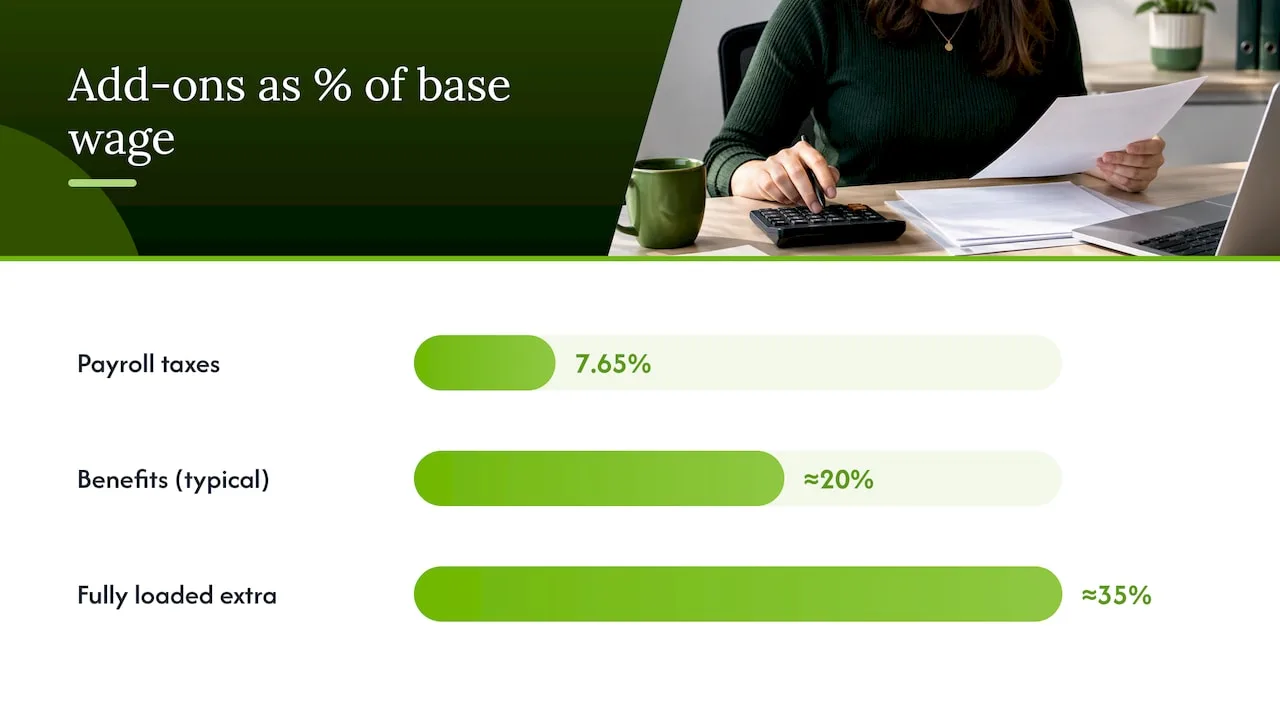
On top of wages, you owe a set of mandatory payroll taxes. The IRS Form 941 instructions lay out employer responsibilities clearly: you pay 6.2% of wages for Social Security and 1.45% for Medicare, matching what you withhold from the employee's paycheck. Add Federal Unemployment Tax (FUTA) and your state's unemployment insurance rate, which varies by state and your claims history.
Then come the costs that don't show up on a tax form:
- Benefits: health insurance, retirement matching, and paid time off, which together often add 15% to 25% of base wage.
- Workstation and equipment: a desk, computer, phone system, and software licenses.
- Training time: hours spent getting a new hire up to speed on your systems and scripts.
- Ongoing software: scheduling tools, your CRM, and any call management platform.
Put together, the BLS notes that fully loaded employer costs often run 25% to 45% above base wages once you add all of this in, which gives you a quick multiplier for budgeting.
Three Ways to Calculate Your Real Monthly Cost
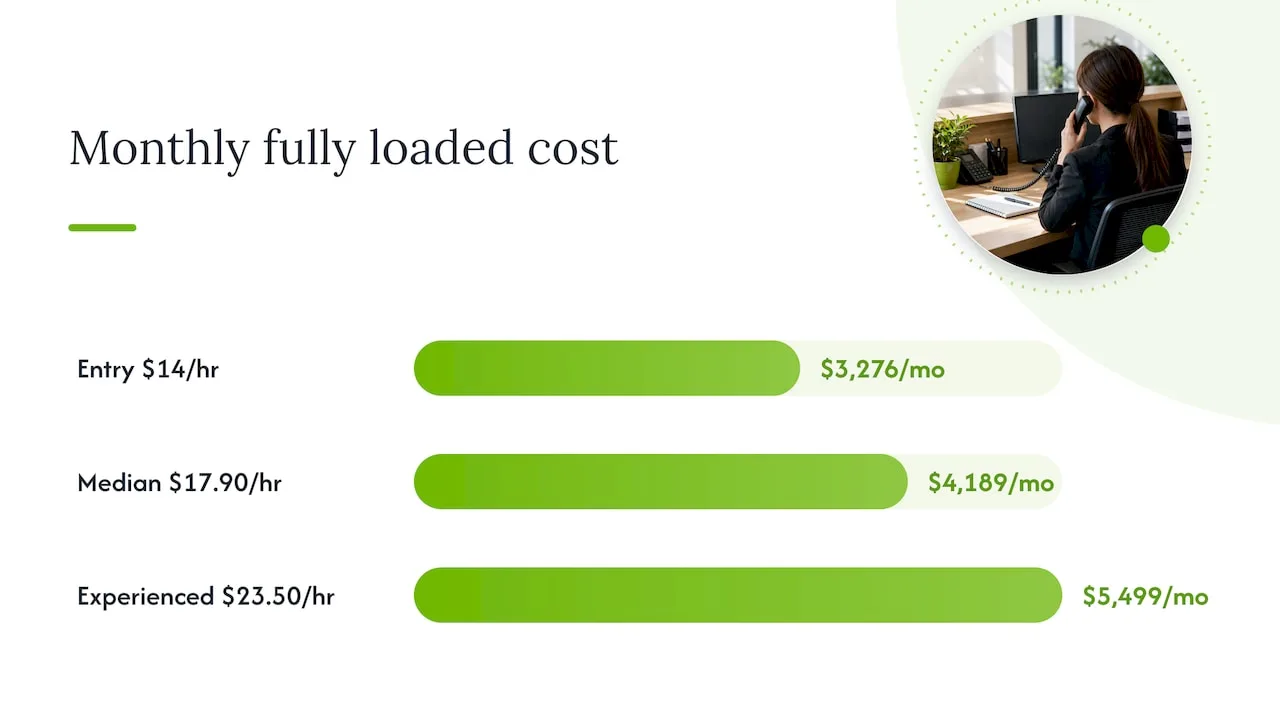
Here's how the math plays out at three common wage levels, using a 1.35 multiplier as a middle-ground estimate for taxes, benefits, and overhead.
- Entry-level ($14/hour): Base annual pay comes to $29,120. Apply the 1.35 multiplier and you land at roughly $39,312 a year, or about $3,276 a month.
- Median wage ($17.90/hour, per the BLS): Base annual pay is $37,232. Factor in Social Security (6.2%), Medicare (1.45%), FUTA, and state unemployment alongside benefits, and your fully loaded total lands near $50,263 a year, or about $4,189 a month.
- Experienced ($23.50/hour): Base annual pay reaches $48,880. With the same multiplier, you're looking at roughly $65,988 a year, or $5,499 a month, and that's before counting overtime if your hours stretch past a standard 40-week shift.
A receptionist earning the median wage costs small businesses roughly $4,189 a month fully loaded, once payroll taxes and benefits are factored in, not just the base paycheck.
If your office fields around 500 calls a month, that median-wage scenario works out to roughly $8.38 per call handled, a number worth keeping in mind as you compare alternatives.
Comparing In-House, Virtual, and AI Receptionist Pricing
Once you know your fully loaded in-house number, the comparison against outsourced options gets a lot clearer.
Virtual receptionist services typically price by the minute, by the call, or as a flat monthly retainer. Low-end plans start around $100 to $300 a month for limited call volume, while higher-tier plans with more coverage hours can run $500 to $1,000 or more. We've broken down these virtual receptionist cost structures in more depth if you want typical ranges by provider type.
AI receptionist platforms usually follow a subscription model with usage tiers rather than per-minute billing, which makes monthly costs more predictable. The appeal is straightforward as shown in the latest insights on AI receptionist use cases for home service businesses:
- No payroll taxes, workers' comp, or benefits to budget for.
- Coverage that runs nights, weekends, and holidays without overtime pay.
- Software fees and integration costs still apply, but they replace a much larger wage and tax bill.
Pro Tip: To estimate your break-even point, divide the difference between your fully loaded in-house cost and your monthly service fee into any one-time setup costs. Most small businesses find the switch pays for itself within the first month or two.
For a deeper look at how virtual and AI options stack up for local businesses specifically, our comparison of virtual receptionists and AI walks through the tradeoffs in more detail.
The Hidden Costs Most Budgets Miss
Wages and taxes are the obvious line items. The costs that catch small business owners off guard tend to live in the gaps around hiring and managing someone.
Recruiting itself isn't free. SHRM's 2025 benchmarking data puts the average cost-per-hire for nonexecutive roles at roughly $5,475, a figure that covers job postings, interview time, and onboarding.
Payroll processing adds its own layer of complexity. The IRS Publication 15 guidance explains that even when you outsource payroll to a PEO or payroll service, you remain responsible for tax compliance and filings unless you've set up a certified arrangement.
Other costs worth budgeting for:
- Overtime coverage: paying time-and-a-half when your receptionist covers extended hours or fills in during busy seasons.
- Turnover: replacing a receptionist means repeating the recruiting cost and losing institutional knowledge.
- Manager time: supervising, scheduling, and covering for a single point of failure when they're out sick or on vacation.
How to Decide What's Right for Your Business
Use these questions to work through the decision systematically:
- How many calls do you handle monthly? Low volume often favors a virtual or AI option over a full-time hire.
- Do you need someone physically on-site for greeting visitors or handling mail, or is phone and scheduling coverage enough?
- How much does unpredictability cost you? A fixed monthly subscription removes the volatility of overtime, sick days, and turnover.
- What's your comfort level with automated systems handling customer data and appointment scheduling?
- Could a short pilot answer your questions faster than a hiring decision? Track answered calls, appointments booked, and leads captured over two to four weeks before committing either way.
If your fully loaded in-house estimate comfortably exceeds what a service-based option would cost for the same coverage, that's usually your answer.
When Hiring In-House Still Makes Sense
Hiring in-house makes the most sense when you need a physical presence, someone managing a front desk, greeting clients, or handling tasks far beyond answering the phone. For call handling, scheduling, and after-hours coverage specifically, the math rarely favors a full-time hire once you've run the fully loaded numbers above. We've seen businesses treat a short trial of an automated system as a cheap way to test demand before locking in a five-figure annual commitment. The data from that trial, calls answered, appointments booked, tends to make the decision for you.
— Serhii
Try an AI Receptionist Before You Commit to a Full-Time Hire
Before you sign an offer letter, it's worth seeing what automated call answering actually looks like in practice. We built RingPort for local service businesses that need reliable phone coverage without the payroll commitment of a full-time hire.
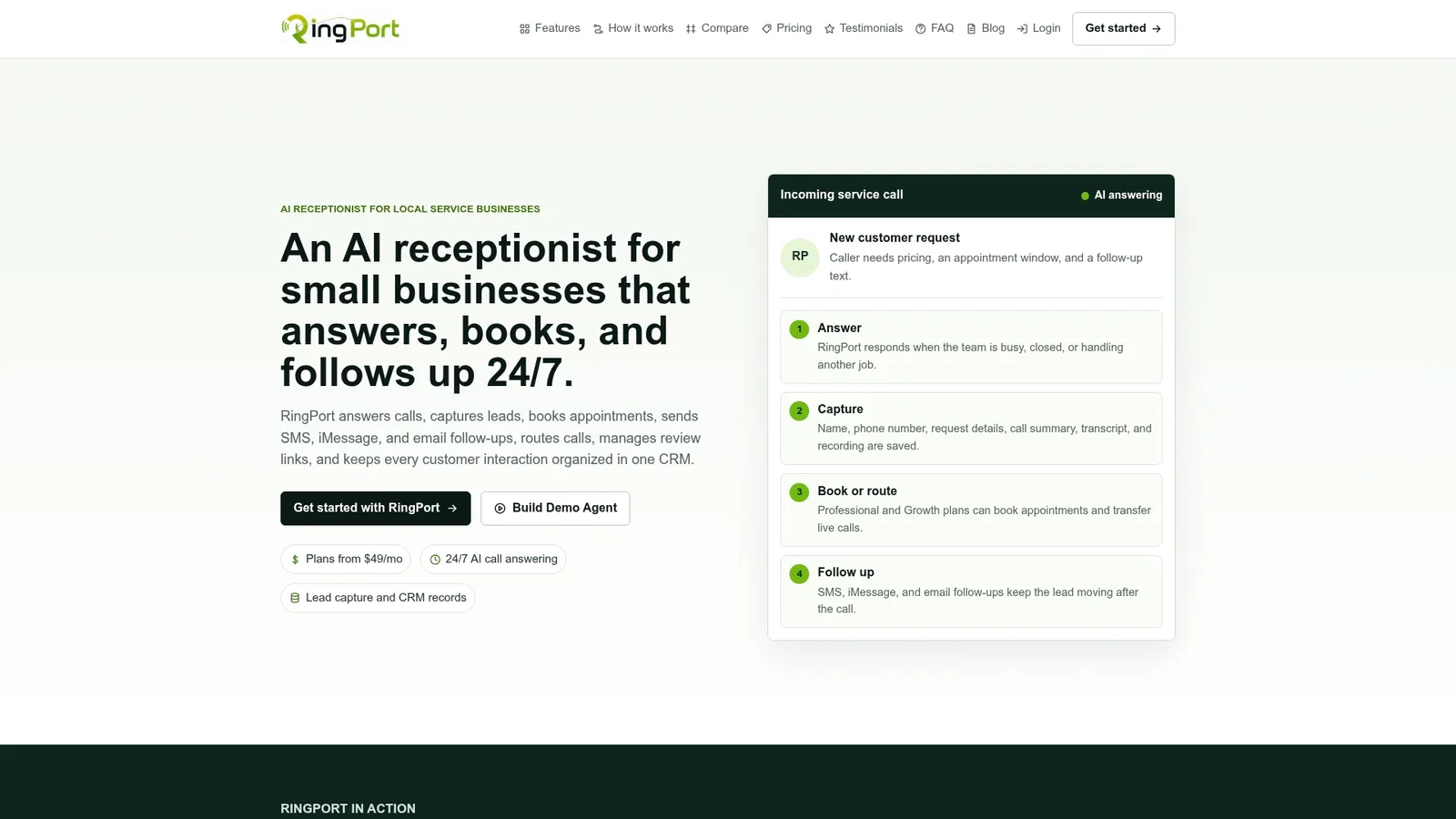
What you get with a plan:
- Automated call answering and appointment booking, including outside business hours.
- Smart call routing and CRM management designed for service businesses.
- Multi-channel follow-up by text, email, and messaging to help keep leads engaged.
Plans start at $49 a month with Starter, scaling up to Professional at $149 and Growth at $299 depending on call volume and features you need. If you want a technical walkthrough first, our Fast Agent page breaks down exactly how the automated call flow works. Run a 30-day test alongside your current setup and compare the numbers yourself.
FAQ
How much should I pay my receptionist?
Pay depends on experience and location, but the national median is $17.90 an hour, or about $37,230 a year, according to the Bureau of Labor Statistics. Entry-level roles often start lower, while experienced or bilingual receptionists can command $23 an hour or more.
How much does RingPort cost?
RingPort pricing starts at $49 a month for the Starter plan, with Professional at $149 a month and Growth at $299 a month depending on your call volume and feature needs. A pay-as-you-go option is also available for businesses with variable usage; pricing details are available at Ringport.
How much should I charge for a virtual assistant?
Virtual assistant and virtual receptionist rates vary widely by scope of work, typically ranging from $15 to $40 an hour for freelance arrangements, or $100 to $1,000+ a month for dedicated receptionist services depending on call volume and coverage hours. Rates depend heavily on whether the work is general admin support or dedicated phone answering.
Can you be a receptionist at home?
Yes, many receptionist roles today are remote or hybrid, especially for virtual receptionist services that handle calls, scheduling, and customer inquiries from a home office setup. What matters most for employers is reliable phone and internet access along with the software needed to manage calls and bookings.
What's the biggest hidden cost of hiring a receptionist?
Recruiting and turnover tend to surprise business owners most, with the average cost-per-hire for nonexecutive roles running around $5,475 according to SHRM's benchmarking data. That figure doesn't include the lost productivity while a position sits vacant or a new hire gets up to speed.
Sources
- Receptionists : Occupational Outlook Handbook : U.S. Bureau of Labor Statistics
- Instructions for Form 941 (Rev. March 2026)
- SHRM Releases 2025 Benchmarking Reports: How Does Your Organization Compare?