
Virtual Receptionist Cost: What Small Businesses Pay
Discover how much small businesses pay for virtual receptionists. Explore costs for AI and human services based on call volume.

How many customers are slipping away before you can answer?
Answer 4 quick questions and get a simple missed-call estimate for your business.
Answer with one tap. Contact details come after your result.
Here is the estimate.
Thanks. Your result was received.
Virtual receptionist cost typically runs in a range from lower to higher monthly fees for AI-powered services and live human agents, depending on call volume and service level, according to market research. Which end of that range you land on depends almost entirely on call volume, coverage hours, and whether you choose a human or AI model.
Here’s what those numbers look like in practice:
-
Very low volume (under 50 calls/month): A per-minute human plan at $0.65–$1.50/min often runs $50–$150/month total. Good for businesses with light, predictable call traffic.
-
Typical small business (100–200 calls/month): A monthly subscription with included minutes lands around $200–$500/month for live agents, or $50–$150/month for an AI subscription.
-
High volume: Live agent plans can reach higher monthly costs while AI flat-rate plans remain predictable regardless of volume.
The bottom line: If you’re handling fewer than 100 interactions per month, a per-minute human plan may be the most flexible option. Above that threshold, an AI subscription almost always delivers better cost predictability and lower total spend.
Key Takeaways
Virtual receptionist cost ranges from $25/month for AI subscriptions to $1,950/month for high-volume live-agent plans, and the right model depends on your call volume, coverage needs, and whether predictable pricing matters more than human touch.
| Point | Details |
|---|---|
| Price ranges by model | AI subscriptions run $25–$500/month; live human services run $129–$1,950/month depending on volume. |
| AI break-even point | AI flat-rate plans typically become cheaper than per-minute human plans above 100–150 interactions per month. |
| In-house cost comparison | A full-time in-house receptionist costs $50,000–$61,000/year all-in; virtual services save 60–95% depending on model. |
| Top vendor questions | Always ask for the published overage rate, rounding method, transfer fees, and data export rights before signing. |
| Ringport’s approach | Ringport offers flat AI subscription pricing with 24/7 answering and appointment booking, removing per-minute overage risk. |
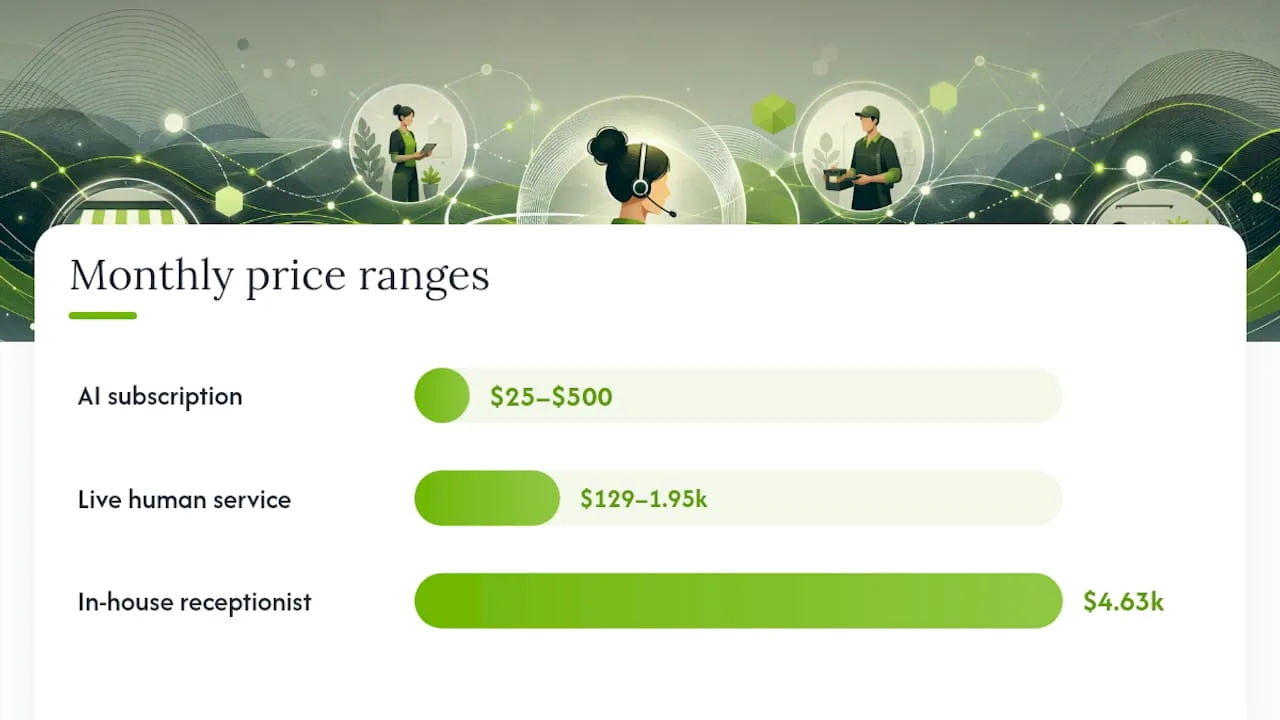
Table of Contents
-
How does virtual receptionist cost compare to hiring in-house?
-
Ringport offers predictable pricing built for service businesses
How does virtual receptionist pricing actually work?
Understanding the pricing model matters more than the headline price. Two plans with similar monthly costs can behave very differently once your call volume shifts.
Per-minute billing charges you for every minute a live agent spends on your calls. Typical rates run $0.65–$1.50 per minute, and most providers round up to the nearest minute or six-second increment. This model is common for human services and works well at low volumes, but costs can spike fast during busy periods.
Per-call billing charges a flat fee per answered call, usually within a low to mid price range per call. It’s easier to budget when your calls are short and consistent, but a spike in long or complex calls doesn’t change your bill.
Monthly subscription tiers with included minutes bundle a set number of minutes into a flat monthly fee. Overage minutes are billed at a higher per-minute rate within a typical market range. These plans suit businesses with predictable, moderate volume.
Message-only plans handle calls by taking a message and routing it to you. They’re the most affordable live-agent option, typically at the low end of the $129–$1,950/month range, but they don’t book appointments or handle complex interactions.
AI flat subscriptions charge a fixed monthly fee regardless of call count. No per-minute charges or overage surprises. These plans cover a broad range suitable for different business sizes.
A few billing behaviors to watch for across all models:
-
Rounding rules: Some providers round up to the nearest full minute; others use six-second increments. On a 200-call month, that difference adds up.
-
Setup fees: One-time onboarding fees of $50–$300 are common for human services. AI platforms often waive them.
-
After-hours premiums: Some live-agent plans charge 10–25% more for calls outside business hours.
-
Contract minimums: Month-to-month plans exist, but annual contracts often unlock 10–20% discounts.
-
Simultaneous-call limits: Some plans handle only one call at a time; overflow goes to voicemail.
Pro Tip: If your call volume is under 50 interactions per month, a per-minute plan gives you the most flexibility. Once you consistently exceed 100–150 interactions per month, a flat AI subscription almost always costs less and removes the anxiety of watching your minute counter.
Sample monthly costs for common small-business call volumes
Running your own numbers is the fastest way to know which model fits. The calculations below use realistic assumptions for small service businesses.
-
Collect your inputs: Pull your last 90 days of call logs. Note total calls per month and average call length in minutes.
-
Map to the model: Multiply calls × average length to get total monthly minutes. For per-call plans, use call count directly.
-
Add extras: Factor in after-hours calls (apply any premium), transfer fees if charged separately, and amortized setup costs.
-
Compare across models: Run the same volume through per-minute, per-call, and subscription scenarios side by side.
A few things stand out in this comparison. Per-call pricing penalizes low-volume businesses with short calls, since you pay the same flat fee whether a call lasts 90 seconds or 5 minutes. Per-minute pricing scales linearly, which is predictable but expensive at higher volumes. AI subscriptions break the linear cost curve entirely. At 150 calls per month, the gap between a per-minute plan and an AI plan can be $400/month or more.
What actually increases or reduces your monthly bill
Price isn’t just about the model. Several specific features and usage patterns can push your bill significantly higher or lower.
Volume drivers that increase cost:
-
Higher call count and longer average handle time directly multiply per-minute charges
-
24/7 coverage, especially overnight and weekend hours, often carries a premium on human plans
-
Bilingual support (Spanish/English, for example) typically adds $50–$150/month on live-agent plans
-
Appointment booking and calendar integrations are sometimes bundled, sometimes charged as add-ons
-
HIPAA-compliant call handling for medical or health-adjacent businesses adds compliance overhead and often a fee premium
-
CRM integrations and webhook connections may be gated behind higher subscription tiers
-
Simultaneous-call capacity beyond a single line usually requires a higher plan tier
Red flags to watch for in vendor pricing:
-
Vague overage language (“standard rates apply”) with no published per-minute overage figure
-
Per-transfer charges that aren’t disclosed upfront, which can add $0.50–$2.00 per warm transfer
-
Billable hold time, where you’re charged while a caller is on hold waiting for your staff
-
Auto-renewal clauses with 30-day cancellation windows buried in service agreements
-
Data export limitations that lock your call logs or contact records inside the platform
Watch your overage rate closely. A plan that looks affordable at its base price can become the most expensive option if your volume runs 20% over the included minutes. Always ask for the published overage rate in writing before signing.
HIPAA compliance and SLA guarantees are two features that consistently affect pricing. A provider offering a guaranteed response time under 20 seconds or documented HIPAA-compliant call handling will typically charge more than one without those commitments. For medical offices, dental practices, or any business handling protected health information, that premium is non-negotiable.
How to estimate your monthly bill before you commit
You don’t need a spreadsheet to get a reliable cost estimate. A simple four-step process works for most small businesses.
-
Pull 90 days of call data. Count total inbound calls and calculate your average call length. Most phone systems or carrier dashboards show this. If you don’t have data, estimate conservatively: 3–4 minutes per call is typical for service businesses.
-
Calculate monthly minutes. Multiply calls per month by average call length. A business taking 120 calls at 3.5 minutes each generates 420 minutes per month.
-
Apply the pricing model. At $1.00/min, 420 minutes = $420/month. At $5/call, 120 calls = $600/month. An AI subscription covering that volume might run $100–$200/month flat.
-
Add after-hours and extras. If 30% of your calls come after hours and your provider charges a 15% premium, add that to your per-minute or per-call total. Include amortized setup fees (divide a one-time $200 setup fee by 12 months = $17/month).
Worked example: A home services company receives 150 calls per month. Average call length is 4 minutes. That’s 600 minutes per month. At $0.85/min (mid-range per-minute rate), the bill is $510/month. A monthly subscription plan with 500 included minutes and $1.50/min overage would cost the base fee plus 100 overage minutes ($150 extra). An AI flat subscription at $150/month covers the same volume with no overage.
The single assumption that changes your estimate most is average call length, not call count. Run your estimate at both your current average and a worst-case scenario (add 2 minutes) to see your exposure.
Pro Tip: Ask any live-agent provider for a 30-day usage report from a comparable client in your industry. Real usage data from a similar business is far more reliable than your own estimate, especially if you’re switching from voicemail.
How does virtual receptionist cost compare to hiring in-house?
Hiring a full-time receptionist costs far more than most small business owners expect once you account for everything beyond the base salary. BLS occupational data provides the authoritative wage baseline, and industry analyses typically apply a 1.25–1.4x multiplier to account for employer-side costs like payroll taxes, health benefits, paid time off, and equipment.
An in-house receptionist runs roughly $50,000–$61,000 per year all-in, or about $4,200–$5,100/month. That’s before you factor in turnover costs, which average several thousand dollars per replacement hire.
Switching to a live virtual service typically delivers significant savings compared to a full-time in-house hire. AI subscription models generally provide even greater savings at equivalent call volumes. The exact figure depends on your volume and plan choice, but even mid-tier live-agent plans represent substantial reductions from all-in employee costs.
One thing in-house comparisons often miss: a full-time employee covers roughly 40 hours per week. A virtual or AI receptionist covers your phones 24/7 without overtime, sick days, or vacation gaps. For service businesses where a missed call after 5 PM means a lost job, that coverage difference has real revenue implications.
How to choose the right plan and negotiate a better deal
Choosing a plan isn’t just about finding the lowest price. It’s about matching the pricing model to your actual usage pattern and making sure the contract terms don’t create surprises later.
Buying checklist:
-
Confirm the pricing model (per-minute, per-call, or flat subscription) and run your own volume estimate against it
-
Check whether 24/7 coverage is included or costs extra
-
Verify which features are bundled vs. add-on: appointment booking, CRM sync, call transfers, bilingual support
-
Ask about HIPAA compliance if you handle any health-related customer data
-
Review the overage rate and the simultaneous-call limit in writing
-
Confirm data export rights so your call logs and contacts aren’t locked in the platform (relevant to vendor privacy practices)
-
Check the cancellation policy: 30-day notice vs. end-of-term only
Eight questions to ask every vendor:
-
How do you round call time: per second, per six seconds, or per full minute?
-
What is the published overage rate if I exceed my included minutes or calls?
-
Is there a setup or onboarding fee, and is it refundable if I cancel within the trial period?
-
How long does onboarding take before my calls are being handled correctly?
-
What is the cancellation process, and is there an early-termination fee?
-
Can I export all call recordings, transcripts, and contact data at any time?
-
Do you charge separately for warm transfers or call routing?
-
What response-time SLA do you guarantee, and how is it measured?
Negotiation tips: Ask for a usage cap that prevents overage charges above a set dollar amount. Request trial pricing for the first 60 days at a reduced rate while you validate volume. If your business is seasonal, ask for temporary credits or paused billing during slow months.
Common gotchas and how to test a plan during your trial
Free trials are worth more than most buyers realize, but only if you use them deliberately. Most businesses treat a trial as a passive observation period. The ones who get the most out of it run specific tests.
Common pricing and quality gotchas:
-
Billable hold time: Some providers charge per-minute while a caller is on hold. A 2-minute hold on a 3-minute call means you’re billed for 5 minutes.
-
Transfer charges: Warm transfers (where the agent stays on the line until your staff picks up) are sometimes billed separately at $0.50–$2.00 per transfer.
-
Simultaneous-call limits: If two calls come in at once and the plan only handles one, the second goes to voicemail. This is a real problem during peak hours.
-
Poor call routing: If the agent can’t follow your routing script correctly, you’ll spend time manually redirecting calls, which defeats the purpose.
-
Data lock-in: Some platforms don’t allow full export of call recordings or contact records without a paid data request.
-
Auto-renewal traps: Plans that renew annually with only a 15-day cancellation window require you to set a calendar reminder the day you sign up.
Trial test script: During your trial period, run these specific tests:
-
Simulate a peak-hour scenario by having three calls come in within five minutes. Check whether all are answered or whether some go to voicemail.
-
Request a warm transfer to your cell phone and note whether the agent stays on the line and how long the transfer takes.
-
Ask for a full export of your call log and any contact records captured during the trial. Confirm the format is usable.
-
Review the billing report at the end of week one. Compare billed minutes to your own call log to check for rounding discrepancies.
Pro Tip: If your trial uncovers higher-than-expected volume, use that data immediately to negotiate a credit or a plan adjustment before the billing cycle begins. Providers would rather keep you at a slightly lower margin than lose you to a competitor.
Choosing by cost vs. choosing by outcome
Price per minute is easy to compare. Outcome is harder to measure but matters more.

The businesses that get the most value from a virtual receptionist aren’t the ones who found the lowest per-minute rate. They’re the ones who tracked what happened to their leads after the phone was answered. Research on online sales leads shows that lead value drops sharply when follow-up is delayed, which means a receptionist that answers at 9 PM and books an appointment on the spot is worth more than one that takes a message for a morning callback.
Three KPIs worth tracking from day one: appointment booking rate (what percentage of inbound calls result in a booked appointment), lead-to-customer conversion rate (how many booked appointments become paying clients), and cost per booked appointment (your monthly receptionist spend divided by appointments booked). These three numbers tell you whether you’re buying a phone-answering service or a revenue-generating asset. A plan that costs $300/month and books 40 appointments has a cost per booked appointment of $7.50. A plan that costs $150/month and books 10 appointments costs $15 per booking. The cheaper plan is actually more expensive where it counts.
Ringport offers predictable pricing built for service businesses
Most per-minute plans punish you for growth. Every new customer, every busy season, every marketing campaign that works means a higher phone bill. Ringport is built on the opposite logic: a flat AI subscription that covers 24/7 automated call answering, appointment booking, CRM workflows, and smart call routing without a per-minute meter running in the background.
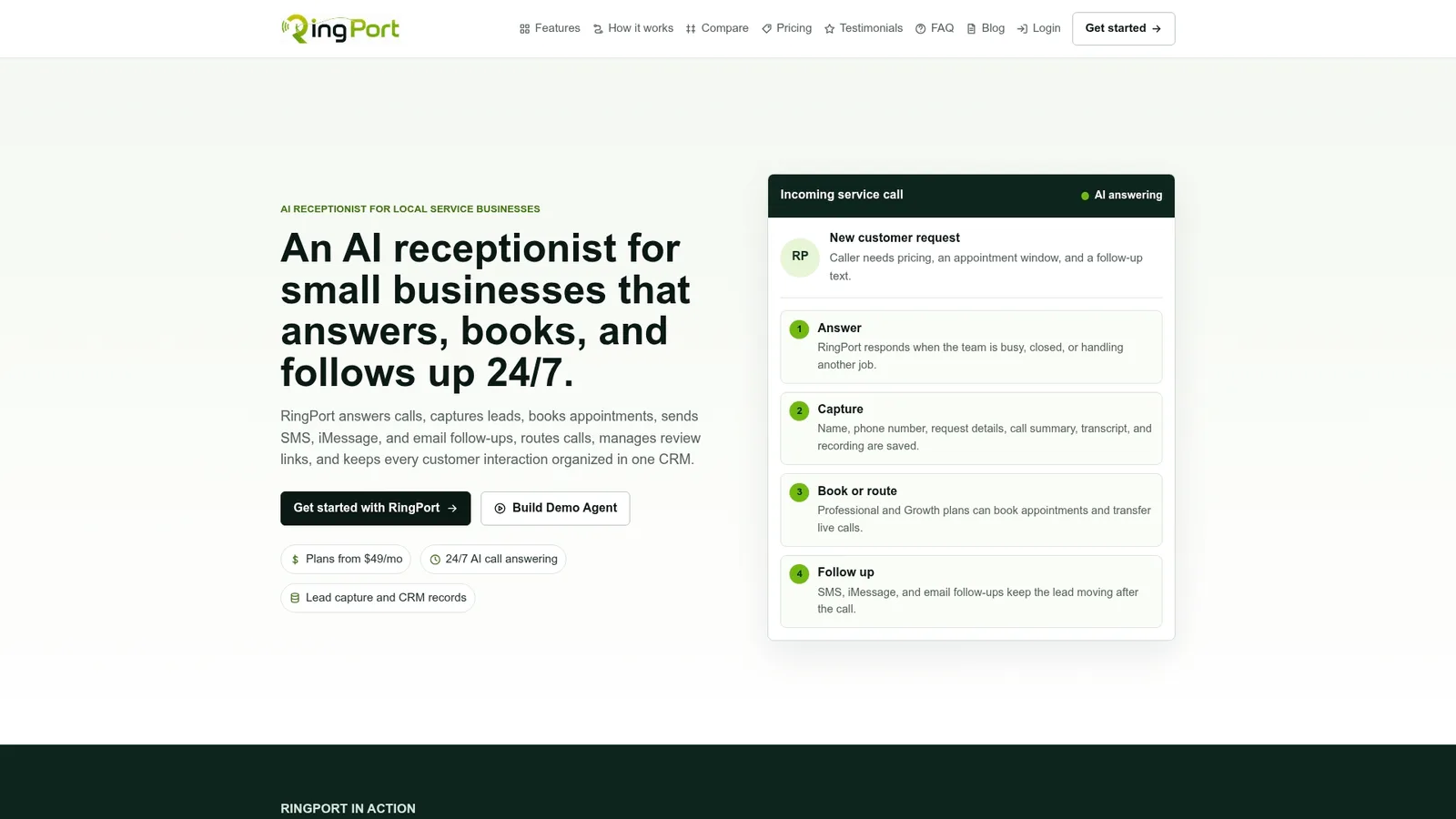
For local service businesses, that means no overage surprises when a promotion drives call volume up, no after-hours premium for calls that come in at 10 PM, and no setup fee to get started. Ringport’s subscription tiers scale by usage level, not by the minute, so your monthly cost stays predictable as your business grows. Optional add-ons for outbound calling, SMS follow-up, and messaging credits are available when you need them, without forcing you into a higher base plan. If you’re ready to see what predictable, appointment-focused call handling looks like for your business, start with Ringport and put the per-minute math behind you!
Sources
-
Virtual Receptionist Pricing: What Does It Actually Cost in 2026? | Life Inside
-
Receptionists and information clerks - Occupational Outlook Handbook - BLS
-
The short life of online sales leads | Harvard Business Review