
Warm Transfer vs Cold Transfer: What Every Team Should Know
Discover the crucial differences between warm transfer and cold transfer. Learn how each impacts customer satisfaction and call efficiency.

How many customers are slipping away before you can answer?
Answer 4 quick questions and get a simple missed-call estimate for your business.
Answer with one tap. Contact details come after your result.
Here is the estimate.
Thanks. Your result was received.
A warm transfer preserves customer context by briefing the receiving party before connecting the call. A cold transfer sends the caller straight through without that briefing. That single difference shapes almost everything downstream: how often customers repeat themselves, how long calls take, and whether a customer hangs up frustrated or feels genuinely taken care of.
The trade-off is simple to state and harder to manage in practice. Warm transfers protect context but cost agent time. Cold transfers move faster but push more risk onto the customer, who has to re-explain their issue to a stranger. Both approaches have a real place in a well-run phone system, but only if your team knows which one to use and when.
Here's what changes depending on which type you use:
- Drop rate — cold transfers see more abandoned calls when callers get bounced around
- Repeat information requests — customers explaining themselves twice frustrates them fast
- CSAT scores — context continuity is one of the clearest levers for customer satisfaction
Key Takeaways
Warm transfers protect customer context and satisfaction at the cost of agent time, while cold transfers trade that context away for speed, and the right choice depends on call complexity and customer value.
| Point | Details |
|---|---|
| Match transfer type to stakes | Use warm transfers for escalations and specialists; cold transfers for simple, high-speed routing. |
| Keep consults under 30 seconds | A tight brief protects context without adding meaningful hold time. |
| Track callback and drop rate | These metrics react faster than CSAT to changes in transfer policy. |
| Consider digital context-passing | Structured context cards deliver most warm-transfer benefits without tying up a second agent. |
| Automate after-hours coverage | Tools like Ringport preserve context on every call without added headcount. |
Table of Contents
- Warm Transfer vs Cold Transfer: How Each One Actually Works
- Pros and Cons of Warm and Cold Transfers
- When to Choose a Warm Transfer vs a Cold Transfer
- Best Practices for Executing a Warm Transfer Well
- How Digital Warm Transfers and AI Receptionists Close the Gap
- Get 24/7 Context-Aware Call Handling Without Adding Headcount
- Why the Real Answer Is "Both, With Rules"
- Sources
Warm Transfer vs Cold Transfer: How Each One Actually Works
The mechanics matter more than the labels. Here's the step sequence for each.
Warm transfer (also called attended or assisted transfer):
- The first agent puts the caller on hold
- The agent calls or messages the receiving party and briefs them on the issue, the customer's name, and any relevant history
- The agent bridges the call, introduces both parties, then drops off the line
Cold transfer (also called blind or unattended transfer):
- The agent routes the caller directly to an extension, department queue, or voicemail box
- No briefing happens beforehand. The receiving party picks up cold, with zero context
A warm transfer means the originating agent briefs the receiving agent before connecting the caller, which is the defining technical distinction between the two methods. A few related variations show up across phone systems: a conference transfer keeps all three parties on the line simultaneously rather than dropping the first agent off, a voicemail transfer routes a caller straight to a mailbox when no live agent is available, and a digital or contextual handoff passes a written summary alongside the call instead of a live verbal briefing.
Pros and Cons of Warm and Cold Transfers
Each method has a real upside, and each one has a cost that shows up somewhere in your metrics.
Warm transfer benefits:
- Context carries over, so customers rarely have to repeat themselves
- First contact resolution tends to improve because the receiving agent starts already informed
- Customer satisfaction scores usually run higher on warm-transferred calls
Warm transfer costs:
- Adds handling time, since two agents are briefly occupied by one call
- Requires enough staffing that a second agent is actually available to brief
Cold transfer benefits:
- Executes almost instantly, which keeps queue times down
- Works well for high-volume, low-complexity routing where speed matters more than nuance
Cold transfer costs:
- Higher risk of callback and abandonment when the receiving party has no context
- Customer effort increases noticeably, since the caller becomes the one responsible for continuity
Vendor and contact-center research consistently finds that cold transfers raise the risk of repeat information requests and higher drop or callback rates when no context travels with the call. That's the mechanism behind most of the metric shifts teams see after switching transfer policies: average handle time climbs slightly with warm transfers, but callback rate and CSAT often move in the opposite, more favorable direction.
Pro Tip: Track callback rate for 30 days after any change to your transfer policy. It's a faster, cleaner signal than CSAT alone, and it shows up almost immediately.
When to Choose a Warm Transfer vs a Cold Transfer
Neither method is right by default. The decision comes down to complexity, stakes, and how much waiting the customer can tolerate.
Use a warm transfer when:
- The issue is escalating and the customer is already frustrated
- The call needs a specialist who requires context to be useful on pickup
- The account is high-value or the relationship matters to retention
- The topic is sensitive or emotionally charged
A cold transfer is acceptable when:
- The routing is simple, like connecting to a known extension or department
- The call is urgent and speed matters more than a briefing
- Your CRM automatically surfaces context to the receiving agent through a screen pop, so no live consult is needed
Industry guidance backs this pattern directly: warm transfers should be used strategically for escalations, specialized handoffs, and emotionally charged calls rather than as a blanket policy for every call.
Give your team three quick questions to run through before transferring any call: How complex is the issue? How much is this customer or account worth to you? And what does the customer lose by waiting an extra 20 seconds for a proper handoff? If the answers point toward complexity and value, brief first. If they point toward simplicity and urgency, route directly.
Best Practices for Executing a Warm Transfer Well
A warm transfer only delivers its benefit if the consult is fast and the customer isn't left wondering what's happening.
- Keep the consult brief to 15 to 30 seconds. Longer than that, and you're adding real hold time for no extra benefit.
- Lead with the essentials: customer name, issue in one sentence, and anything already tried.
- Tell the customer what's happening before you put them on hold: "I'm going to connect you with our billing specialist, Maria. Give me just a moment to fill her in."
- Confirm the receiving agent has what they need before bridging the call, then introduce both parties by name.
- Run periodic QA checks specifically on transfer calls, not just on the call as a whole, since transfer quality often gets missed in general scoring.
A consistent brief format, covering who the customer is, what they need, and what's already happened, is one of the most reliable ways contact centers keep warm transfers fast and repeatable across an entire team.
Training checkpoints matter here more than most teams expect. New agents tend to either over-explain during the consult (wasting hold time) or under-explain (defeating the purpose of the warm transfer entirely). Role-play both failure modes during onboarding.
What a Warm and Cold Transfer Actually Sound Like
Scripts make the difference between theory and practice. Here's what each transfer type looks like in a real call.
Warm transfer transcript:
- Agent: "I'm going to bring in our scheduling lead to get this sorted. One moment while I fill her in."
- (Hold, 20-second consult)
- Agent: "Maria, this is James. He's had two missed deliveries this week and needs a redelivery window today."
- Maria: "Got it, James, I can see the order now. Let's fix that today."
Cold transfer transcript:
- Agent: "I'll transfer you to scheduling now."
- (Call routes directly, no briefing)
- Receiving agent: "Scheduling department, how can I help you?"
The cold version isn't wrong, but the caller has to start over from scratch. Avoid transferring cold on any call where the customer has already explained something complicated once.
How Digital Warm Transfers and AI Receptionists Close the Gap
Not every small business has a second agent standing by to take a live consult. That's where digital, or contextual, handoffs come in: instead of a verbal briefing, a structured context card travels with the call, carrying the caller's name, account status, issue summary, and recent actions so the receiving party can pick up already informed.
This approach delivers most of the practical benefit of a live warm transfer without occupying a second person's time for the length of a consult:
- Context still travels with the caller, so repeat explanations drop
- No agent gets tied up bridging a three-way call
- Coverage extends to 24/7, which matters for service businesses fielding calls outside normal hours
Ringport, an AI receptionist built for local service businesses, handles this by automatically answering calls, routing them intelligently, and passing structured context (via CRM notes, call summaries, or smart routing rules) to whoever picks up next, human or automated. Structured context-passing patterns like these are increasingly common across sales and support handoffs more broadly, as outlined in collaboration patterns built for sales-to-finance handoffs.
Pro Tip: If your team is under five people, automation-driven context passing is almost always more sustainable than trying to staff a live warm-transfer consult on every call.
Manual warm transfers still make sense for high-stakes escalations where a human judgment call matters. Automation is the better fit for everyday routing and after-hours coverage.
Get 24/7 Context-Aware Call Handling Without Adding Headcount
Solo operators and small teams rarely have the staffing to run live warm-transfer consults on every call, and cold-transferring every caller isn't a real answer either. Ringport was built specifically for this gap: it answers calls around the clock, routes them with smart call-handling rules, and keeps account and appointment context attached to every interaction so nothing gets lost between the first ring and the booked job.
For a home services company, salon, or medical office running lean, that means customers stop repeating themselves, appointments get booked without a human standing by, and the business captures leads at 2 a.m. just as reliably as at 2 p.m. Ringport's CRM management and follow-up features work in the background so the "warm" part of the transfer happens automatically, without another payroll line.
Why the Real Answer Is "Both, With Rules"
Most advice on this topic treats warm and cold transfers as a competition, as if one is simply the better practice. That framing misses the point. The research supports a policy, not a preference: warm transfers for complexity and stakes, cold transfers for speed and simplicity, with clear rules so agents aren't guessing call by call.
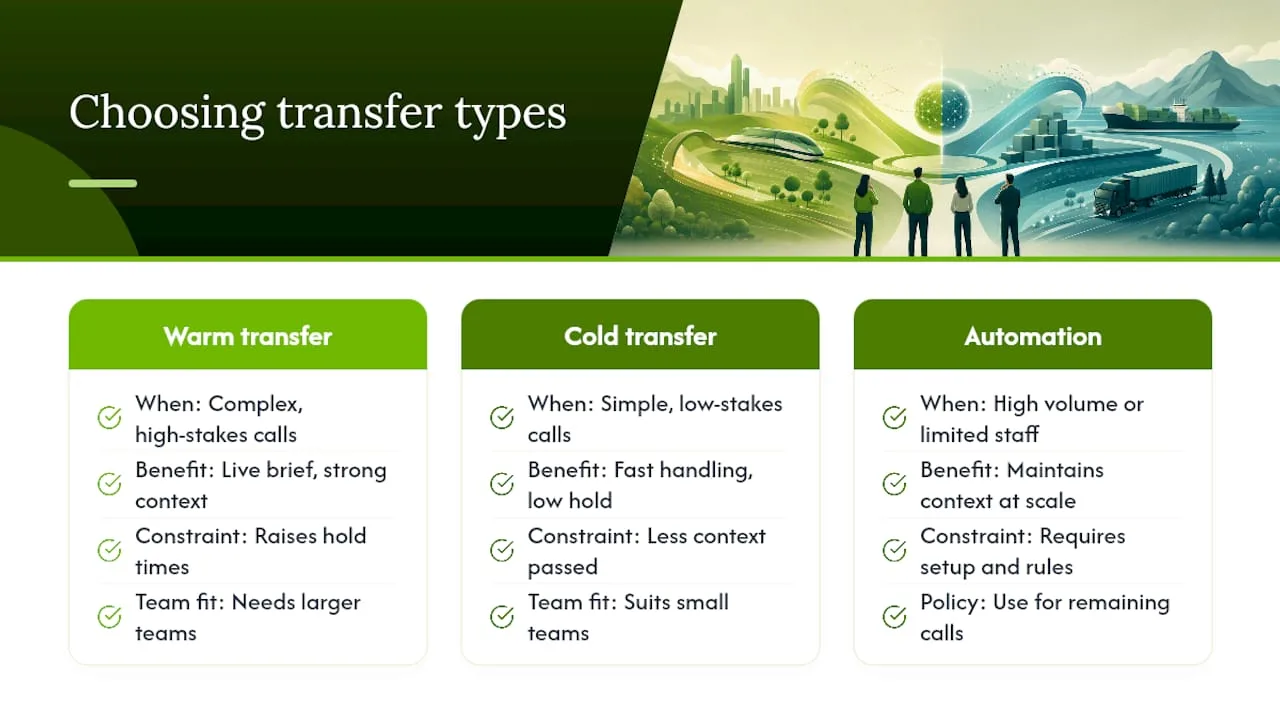
What gets overlooked most often is staffing reality. A five-person team cannot run live warm consults on every call without letting hold times balloon, yet the conventional advice rarely accounts for that constraint. This is exactly where context-aware automation earns its place, not as a lesser substitute, but as the only realistic way small teams deliver context continuity at the volume modern phone systems demand.
If you're setting policy for the first time, don't start with scripts. Start by deciding which calls are complex or valuable enough to justify a live brief, and let automation absorb everything else.
— Serhii
Sources
- Call transfer - Wikipedia
- 3 ways to improve your customer experience with warm transfers - TechSee
- Warm transfer vs cold transfer explained | NICE