Speed to Lead: The SLA That Wins the First Conversation
Responding within five minutes to leads boosts your conversion rates. Discover why speed to lead is crucial for winning sales conversations.

How many customers are slipping away before you can answer?
Answer 4 quick questions and get a simple missed-call estimate for your business.
Answer with one tap. Contact details come after your result.
Here is the estimate.
Thanks. Your result was received.
For high-intent inbound leads, the target is simple: reply within five minutes. Speed to lead measures the gap between the moment a prospect acts (fills out a form, starts a chat, requests a callback) and your first real response, not the moment your CRM logs it. Hit that five-minute window and you convert dramatically more of those leads than teams who wait even 30 minutes, because whoever responds first usually wins the deal.
TL;DR:
- Responding to high-intent leads within five minutes can triple your qualification and booking rates, significantly increasing revenue.
- Most teams still average response times near 42 hours, with automation and better routing reducing delays by targeting immediate, multi-channel touches.
- Building a faster system requires capturing events directly at source, automating lead routing, and using instant booking links or conversational forms to eliminate wait times.
- Measuring response time from the lead's action, not CRM logs, and tracking P90 response times is essential to identify actual coverage gaps and improve deal conversion.
- Implementing AI receptionist solutions can close after-hours gaps and prevent leads from going unanswered, boosting response speed and overall lead engagement.
Table of Contents
- What The Research Says About Lead Response Time
- What Response Time Target Should You Set?
- How To Build A Faster Lead Response System
- How Do You Measure Speed To Lead Correctly?
- What's The Revenue Impact Of Faster Response?
- How RingPort Closes The Response Gap
- Fix Coverage Before You Chase Speed
- Get 24/7 Lead Coverage Without Hiring A Night Shift
- Sources
What The Research Says About Lead Response Time
The Harvard Business Review study on online sales leads is still the benchmark most sales leaders quote, and for good reason: firms that contacted leads within an hour were substantially more likely to qualify them than firms that waited longer. First responders capture a disproportionate share of the pipeline. That's not a marginal edge. It's the difference between owning the conversation and chasing a prospect who already booked a demo with someone else.
The classic InsideSales and MIT research pushed this further, reporting that contact within five minutes produced qualification rates significantly higher than contact after 30 minutes. The qualification curve declines sharply with delay. The exact multiplier varies by study and industry, but the underlying pattern holds up everywhere it's been tested: the qualification curve doesn't decline gradually. It falls off a cliff.
Here's the uncomfortable part. Despite two decades of data proving this, most teams still respond slowly. Perspective AI's 2026 benchmark research found the median first-response time sitting near 42 hours, with only a small share of leads getting a reply inside five minutes. Meanwhile, EmailAnalytics's lead response benchmarking shows the same pattern across sales teams tracked through Gmail and Outlook: the average rep is nowhere close to the target, even when the tools to fix it are inexpensive and widely available.
Why does the gap matter so much? A few behavioral realities explain it:
- Buyers are shopping multiple vendors simultaneously. A slow reply doesn't just delay the sale, it hands the deal to whoever answers first.
- Intent decays fast. The emotional trigger that made someone fill out your form (frustration with a current vendor, an urgent need, a moment of research momentum) fades within minutes, not days.
- Response speed reads as a signal of competence. A prospect who waits 24 hours for a reply reasonably wonders how responsive you'll be after they've signed a contract.
- Human attention is a leaky bucket. Every hour of delay gives a lead more time to get distracted, get busy, or get contacted by a competitor's SDR.
Pro Tip: Track how many of your leads go a full business day without any contact at all. That "never responded in time" bucket usually costs more revenue than your slow median response time does.
None of this means every lead deserves a five-minute sprint. It means the leads that matter most, the ones actively comparing options right now, are the ones where speed compounds fastest.
What Response Time Target Should You Set?
Not every lead deserves the same urgency. A prospect who requested a live demo is in a different psychological state than someone who downloaded a whitepaper, and your SLA should reflect that.
Treat lead response time in three tiers based on intent signal:
High-intent leads (demo requests, pricing page conversions, "call me back" forms) deserve a reply inside five minutes. These prospects are actively comparing vendors right now. Every minute you wait is a minute a competitor might use to get there first.
Real-time channels need even tighter windows. Live chat should get a response in under 30 to 60 seconds, since the visitor is sitting on your site waiting. SMS performs best when the reply lands within a few minutes, since text carries an implicit expectation of quick back-and-forth.
Mid-intent leads (content downloads paired with a form fill, webinar sign-ups with follow-up questions) can tolerate up to one hour without major conversion loss.
Low-intent leads (newsletter signups, generic contact-us submissions with no clear buying signal) are fine within 24 hours, though faster never hurts.
| Lead type | Channel | Target response time |
|---|---|---|
| High-intent (demo, pricing, callback request) | Phone, form | Under 5 minutes |
| Real-time chat | Live chat widget | Under 30 to 60 seconds |
| Real-time text | SMS | Under 5 minutes |
| Mid-intent (content + form) | Email, phone | Under 1 hour |
| Low-intent (newsletter, general inquiry) | Under 24 hours |
Setting a single average target is where most teams go wrong. A median response time of four minutes sounds excellent until you realize your P90 (the response time for your slowest 10 percent of leads) is six hours. Averages hide the leads that got completely dropped. Track median for a general health check, but manage your team against P90, because P90 is where deals actually die. A realistic internal target: get your median under five minutes for high-intent leads, and get your P90 under 30 minutes. If your P90 is still measured in hours, you have a coverage problem, not a speed problem.
How To Build A Faster Lead Response System
Fixing lead response time is an engineering problem disguised as a sales problem. Most teams try to solve it by telling reps to "check their email more often," which almost never works because the failure point is rarely human effort. It's usually the plumbing. Here's the order that actually moves the needle, starting with the fixes that remove the most delay for the least effort.
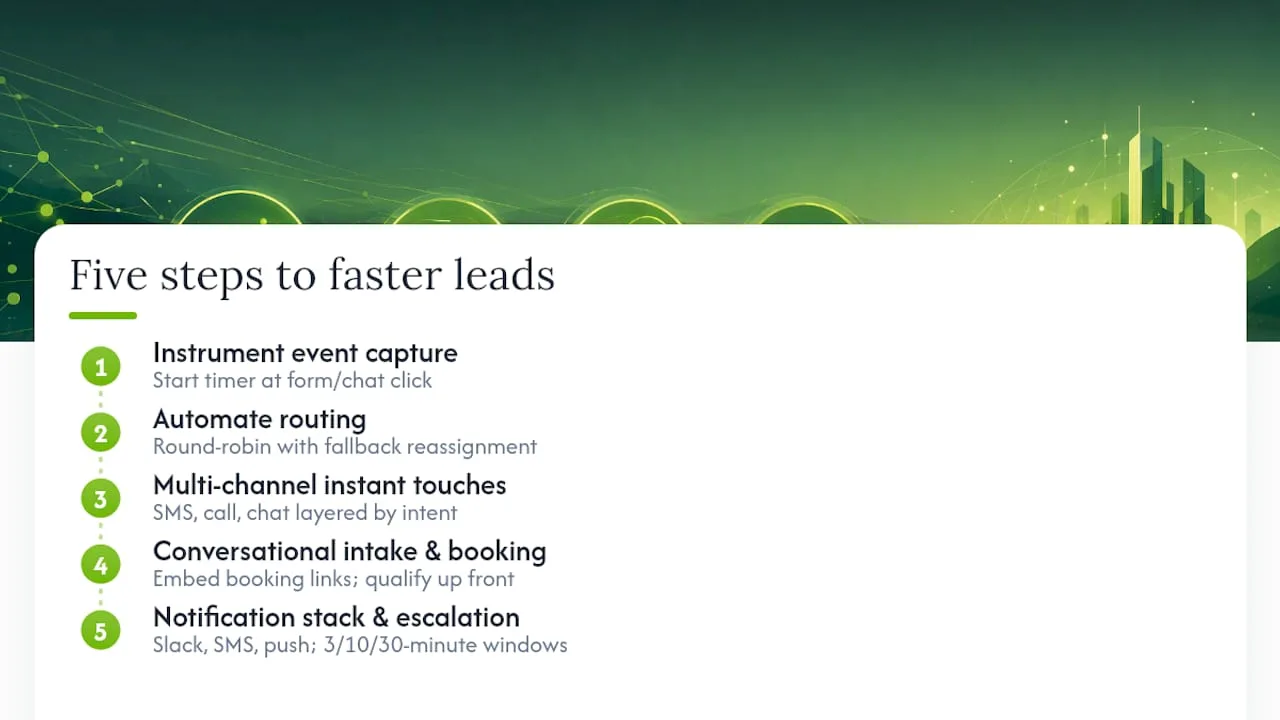
1. Instrument capture at the event source. Your timer should start the instant a lead acts, not when someone notices the notification. That means capturing a timestamp directly from the form submission, the chat session start, or the tracked click, rather than relying on when a rep logs the interaction in your CRM. CRM entry timestamps routinely lag the real event by minutes or hours, and that gap quietly erases your real speed-to-lead number.
2. Automate routing with round-robin and a fallback. Manual lead assignment is the single biggest source of delay in most sales orgs. The RevOps Report's optimization research found that automated routers with fallback rules cut routing delay dramatically compared to manual assignment, since leads no longer sit in a queue waiting for someone to notice them. Build a round-robin that assigns leads instantly, then add a fallback: if the assigned rep doesn't acknowledge the lead within a set window, it reassigns automatically rather than sitting untouched.
3. Fire multi-channel instant touches, not just one email. A single automated email is easy to ignore. Layer channels based on intent: an SMS for high-intent leads (people check texts faster than inboxes), an instant call attempt for phone-provided leads, and a chat-triggered response for anyone already on your site. Each channel catches a different attention pattern.
4. Use conversational intake and booking links to collapse the gap entirely. The fastest possible response isn't a human replying quickly, it's removing the wait altogether. A booking link embedded directly in your confirmation message lets a high-intent lead schedule a call themselves, seconds after submitting the form, without waiting on anyone. Conversational intake forms that ask a qualifying question up front do double duty: they speed up response and improve the context a rep has when they do connect.
5. Build a notification stack that can't be missed. Email alerts alone fail constantly, buried under a hundred other messages. Stack notifications across Slack, SMS, and a dedicated mobile push so a new lead is genuinely hard to ignore. Pair that with deterministic escalation windows: an alert to the owner at 3 minutes, automatic reassignment at 10 minutes, and a manager alert at 30 minutes for anything still untouched. Deterministic timing matters more than clever timing. Everyone on the team should know exactly what happens and when.
6. Cover after-hours with automated but meaningful touches. A huge share of high-intent leads arrive outside business hours, evenings, weekends, whenever a prospect finally has time to research. If your team only works 9 to 5, you're losing every one of those leads to whoever answers first, even if that's an automated system. An after-hours response that confirms receipt, offers a specific next step, and books a callback window closes the gap until a human can take over.

7. Standardize your first-touch script. Consistency in that first message matters as much as speed. A pattern that works across channels: acknowledge the lead's specific request by name, offer two concrete callback times rather than a vague "let's connect," and ask one qualifying question that helps whoever picks up the thread next. That structure takes seconds to execute and dramatically improves the odds the lead responds back instead of going quiet.
Pro Tip: Duty rotations beat "whoever's online" for after-hours and weekend coverage. Assign a specific person (or automated system) ownership for each shift, so no lead depends on someone happening to check their phone.
How Do You Measure Speed To Lead Correctly?
Most teams measure lead response time wrong, and the mistake is almost always the starting point. Measure from the lead's action, form submit, chat session start, tracked click, never from when your CRM logs the record. EmailAnalytics's benchmarking guidance is explicit on this: CRM sync timestamps routinely lag the real event, sometimes by hours, which quietly inflates your reported performance and hides the actual customer experience.
Exclude autoresponders from your "first response" count entirely. An automated "thanks for reaching out" email is not a meaningful reply, and counting it as one lets teams claim fast response times while leads sit untouched by an actual human for hours.
Track two numbers side by side, not one:
- Median response time, which tells you your typical performance and is useful for spotting broad trends.
- P90 response time, which tells you how your worst cases perform and is where most revenue actually leaks.
- Response time broken out by lead source, since paid search leads, referral leads, and organic form fills often carry very different urgency and deserve different SLA tiers.
- Response time broken out by hour of day and by rep, since coverage gaps and individual bottlenecks hide inside a blended average.
Beyond raw speed, track TTQC, time to qualified context. A fast reply that doesn't advance the conversation isn't actually winning anything. TTQC captures how quickly a lead's use case, timeline, and blocker get documented, not just when someone said hello. Pair it with your connect-to-qualified-conversation rate, which tells you what percentage of "fast" contacts actually turned into a real sales conversation rather than a missed callback or a one-line reply.
A useful weekly dashboard includes: median and P90 response time by source, percentage of leads contacted within your SLA tier, never-responded count (leads that got zero human contact within 24 hours), and TTQC trend over the past four weeks. Review it every week, not quarterly. Response time drifts fast when a team member is out or a routing rule breaks, and a monthly review catches that drift three weeks too late.
What's The Revenue Impact Of Faster Response?
Here's a template you can run with your own numbers. Assume your team gets 100 leads per week, and today your baseline contact rate (leads you actually reach) sits at 40 percent, with 20 percent of contacted leads converting to a booked meeting.
Now assume that leads contacted inside your five-minute SLA convert to a booked meeting at double that rate, a realistic outcome given how consistently studies show intent decay working against slow follow-up. If you improve your contact rate to 60 percent by fixing routing and coverage gaps, and your under-SLA leads convert to meetings at 40 percent instead of 20 percent, the math shifts substantially.
| Scenario | Leads/week | Contact rate | Meeting rate | Meetings/week |
|---|---|---|---|---|
| Baseline (slow response) | 100 | 40% | 20% | 8 |
| Improved (fast, routed response) | 100 | 60% | 40% | 24 |
That's a jump from 8 meetings a week to 24, without adding a single new lead source. If your average close rate on booked meetings is 25 percent and your average deal value is $3,000, that's the difference between 2 closed deals a week and 6, a $12,000 weekly swing from response speed alone.
To build your own version: multiply weekly lead volume by contact rate, multiply that by meeting rate, then multiply meetings by your close rate and average deal size. Change one variable at a time (contact rate first, since it usually has the largest room to improve) and you'll see exactly where your speed-to-lead investment pays off fastest.
How RingPort Closes The Response Gap
Most of the playbook above depends on infrastructure that's genuinely hard to build in-house, especially for a small team without a dedicated RevOps function. That's the gap an AI receptionist is built to close.
Ringport operates as a 24/7 automated front line for local service businesses, which directly addresses the two biggest speed-to-lead failure points: after-hours gaps and missed calls. A prospect calling at 9 p.m. on a Sunday to ask about availability gets an immediate, professional answer instead of a voicemail they'll forget to leave.
A few specific ways this maps to the playbook above:
- Automated call answering means the "never responded" bucket, the single most expensive gap in most speed-to-lead audits, shrinks toward zero.
- Smart routing sends calls to the right person or queue instantly, replacing the manual assignment delay that routing automation is designed to eliminate.
- Appointment booking built into the call collapses the gap between "expressed interest" and "meeting confirmed," the same principle behind instant booking links.
- SMS and email follow-up keep a lead warm the moment a call ends, covering the multi-channel touch pattern that improves engagement odds.
Pro Tip: Run an audit of your own missed-call log for one week. Most local service businesses are stunned by how many of those calls were genuine booking intent, not spam or wrong numbers.
The scenario that shows this most clearly: a homeowner calls a plumbing company at 7 a.m. before work, gets no answer, and calls the next competitor on the search results page. An AI receptionist answers that call live, books the appointment, and the business never even knows a lead almost got away.
Fix Coverage Before You Chase Speed
The instinct in most sales organizations is to obsess over shaving seconds off an already-decent response time. That instinct is backward. If your team has any leads sitting in a "never responded" bucket, whether that's 5 percent or 30 percent, that number matters more than your median speed, and it's usually the cheaper problem to fix.
A team with a mediocre four-hour median but zero never-responded leads will consistently outperform a team with a stellar two-minute median and a 15 percent never-responded rate. The math is not close. Every lead that gets zero contact is a guaranteed loss, while a slightly slow contact still has a real shot at conversion.
So the priority order should be: eliminate coverage gaps first (after-hours, weekends, notification failures), then enforce your SLA tiers consistently across the team, then improve the context quality of each first touch through better intake and enrichment. Only after those three are solid does chasing sub-60-second response times start producing meaningful marginal returns, and even then, the gain tends to come from what that fast response accomplishes rather than from speed for its own sake.
If you want a starting point, pull last month's leads and count how many got literally zero contact within 24 hours. That number will tell you more about your revenue leakage than any response-time average you've been tracking.
— Serhii
Get 24/7 Lead Coverage Without Hiring A Night Shift
Ringport is the practical fix for the coverage gap most of this playbook depends on solving: it answers every call, books the appointment, and routes the lead while your team sleeps, takes a lunch break, or handles another customer.
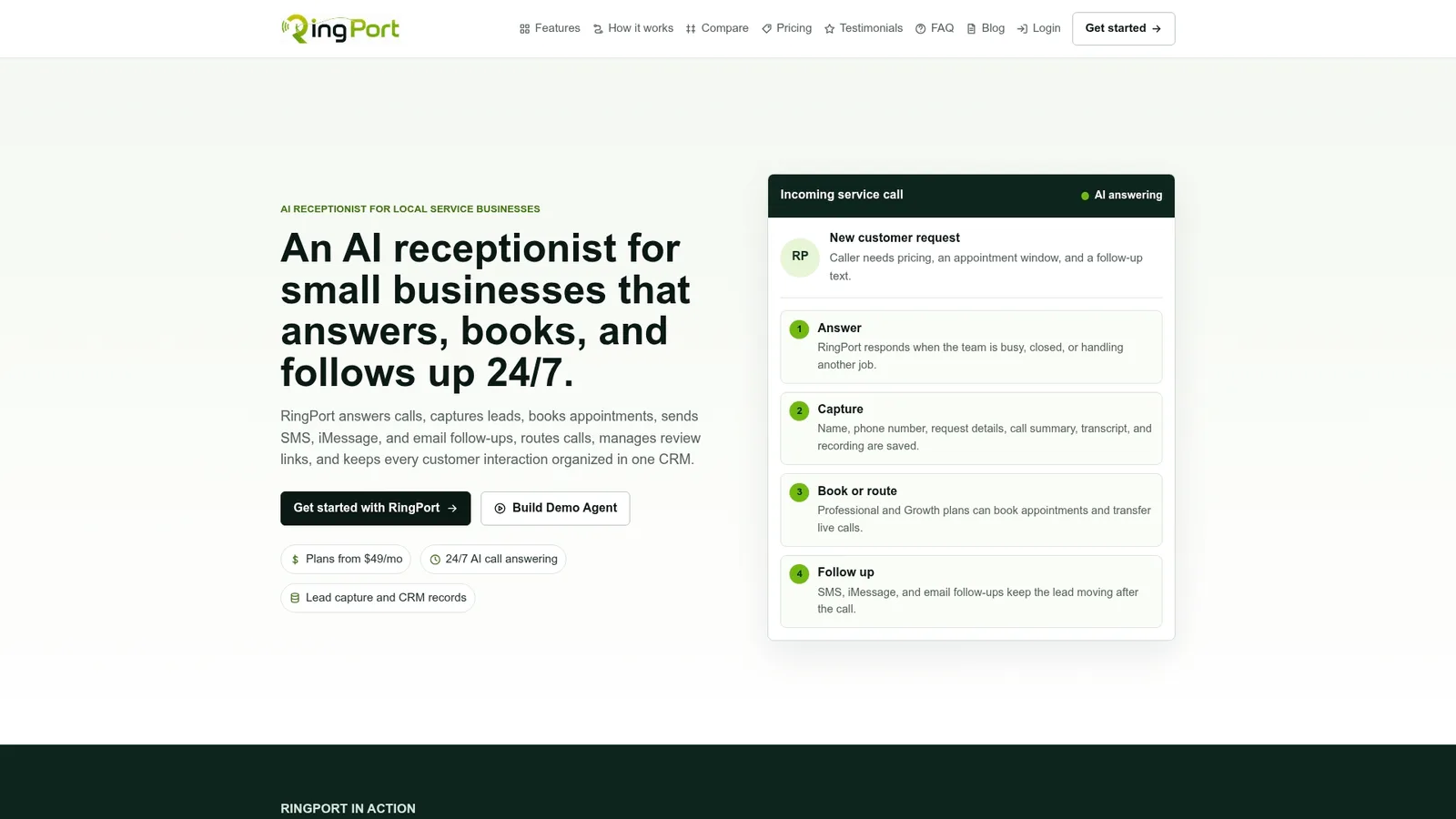
Instead of building a custom routing stack, a Slack alert system, and an after-hours rotation from scratch, Ringport packages all of it into one AI receptionist built specifically for local service businesses. It answers calls around the clock, books appointments directly into your calendar, routes urgent requests to the right person, and follows up by SMS or email so no lead goes cold waiting on a callback. For a solo owner or a small team without a dedicated front-desk staff member, that's the difference between losing a Sunday-night demo request and waking up to a booked appointment.
If your never-responded rate is higher than you'd like to admit, see how RingPort handles your calls and start a trial to see your own missed-call recovery in action.
Sources
- Harvard Business Review — The short life of online sales leads
- EmailAnalytics — Lead response time (2026)
- Perspective AI — Lead response time in 2026: benchmarks and what actually converts
- The RevOps Report — Speed to lead benchmarks and optimization