24/7 Phone Lead Capture for Local Service Businesses, TCPA Safe Setup
Build 24/7 phone lead capture for local service businesses. AI answers calls, books appointments, logs TCPA safe leads, and pushes them into your CRM.

How many customers are slipping away before you can answer?
Answer 4 quick questions and get a simple missed-call estimate for your business.
Answer with one tap. Contact details come after your result.
Here is the estimate.
Thanks. Your result was received.
Use an AI receptionist to answer every inbound call, capture the caller's contact and job details, and book the appointment directly on your calendar, day or night. This closes the gap that costs local service businesses their best leads: the ones who call and hang up when nobody picks up. Tools like RingPort handle this automatically, and the setup, scripts, and compliance rules below show you exactly how to put it to work.
TL;DR:
- Answering calls with an AI receptionist reduces missed leads and can handle most inbound calls 24/7 without additional staff.
- Capture essential caller details—name, phone, service, address, and two appointment times—within the first few seconds to prevent drop-offs.
- Calls answered outside regular hours should be prioritized for testing, as they often have the highest missed opportunity rate.
- Outbound calls using AI voices require prior explicit consent, and recording opt-ins is essential to stay compliant with FCC regulations.
- Tracking answered rate, speed-to-lead, booked rate, and conversions helps optimize the system's effectiveness and increase booked appointments.
Table of Contents
- How phone lead capture works from the first ring
- Setup checklist to start capturing phone leads today
- Scripts and call flows that turn calls into bookings
- TCPA and AI voice rules you need to know
- How to measure and improve your phone lead capture
- What actually matters when you automate phone leads
- RingPort: get started with a working phone lead setup
- Primary sources and further reading
- Sources
- FAQ
How phone lead capture works from the first ring
When a customer calls your business, an AI receptionist answers immediately instead of routing to voicemail or a busy line. It uses a short, guided conversation, similar to a smart IVR, to figure out what the caller needs and where to send them next. Good systems keep this part brief because callers hang up fast when a menu drags on.
From there, the system captures only what it needs to move the lead forward:
- Caller's name and best callback number
- The service they're requesting and, if relevant, their address or zip code
- Preferred appointment times, so scheduling doesn't require a callback
Once it has those basics, the AI receptionist can book the appointment on your calendar, send an SMS confirmation, and log the lead in your CRM, all before the call ends. That's a meaningfully different job than outbound AI telemarketing, which places calls to people who haven't asked for them. Inbound answering responds to someone who already picked up the phone to reach your business, and that distinction matters later when compliance comes up.
Setup checklist to start capturing phone leads today
Getting a phone lead capture system running doesn't take a big project plan. Work through these steps in order and you can be live within a day.
- Choose your number strategy. Port your existing business line or add a local forwarding number. Local numbers tend to get answered more often than out-of-area ones, a pattern covered in RingPort's guide to local presence dialing.
- Set your hours and escalation rules. Define business hours, what happens after hours, and when a call should transfer to a live person instead of staying with the AI.
- Connect your calendar and enable self-booking. Let callers pick an open slot directly, then test a few placeholder bookings to confirm the flow works end to end.
- Link your CRM and set notification rules. Route new leads into your CRM immediately and set alerts so someone sees them fast. Speed matters here, as explained in RingPort's speed-to-lead SLA guide.
- Run a dry test with your team. Call in yourself, have staff call in, and check that bookings, notifications, and confirmations all fire correctly before you go live.
Pro Tip: Test your after-hours flow first. That's when missed calls happen most, and it's the easiest place to prove the system is working.
Scripts and call flows that turn calls into bookings
A short script beats a clever one. Callers want to know they're being heard and that something is happening next, not that they're talking to a polished machine.
Two flows cover most local service calls:
- Quick-book flow for urgent or routine service requests: confirm the service needed, grab name, callback number, and address, then offer the two nearest available time slots.
- Consult or quote flow for jobs that need more detail: ask what the job involves, confirm the address, and set two preferred time windows for a callback or estimate visit.
Keep the required fields to five: name, phone, service requested, address or zip code, and two preferred times. Anything beyond that slows the call down and raises the chance of a hang-up.
Hand off to a live team member when a caller sounds frustrated, asks a question outside the script, or requests a person directly. A simple line works: "Let me get you to someone who can help with that right now." For calls you miss anyway, enable voicemail-to-text so the message becomes a written lead, then follow up with a short text: "Sorry we missed your call. What service do you need, and what times work for a callback?"
Pro Tip: Save your quick-book and consult scripts as templates in your AI receptionist so every caller gets the same clear experience.
TCPA and AI voice rules you need to know
The FCC's February 2024 declaratory ruling confirmed that AI-generated voices fall under the TCPA's restrictions on "artificial or prerecorded voice," which means outbound calls using AI voice technology require prior express consent from the person being called.
That rule targets outbound telemarketing, not a business answering its own inbound line. Still, a few habits keep you safe:
- Never place outbound AI-voice calls without documented, prior express consent.
- Record opt-ins with a timestamp whenever you plan automated SMS or email follow-up.
- Give every follow-up message a clear opt-out instruction.
FCC guidance on stopping unwanted robocalls confirms that AI-generated voice calls are illegal without consumer agreement or an applicable exemption, which is why documentation matters even for a small operation.
How to measure and improve your phone lead capture
You can't improve what you don't track. Four numbers tell you most of what you need to know:
- Answered rate: the share of inbound calls that get picked up instead of going to voicemail.
- Speed-to-lead: how fast a new lead gets a follow-up, a factor RingPort's speed-to-lead guide ties directly to conversion.
- Booked rate: the percentage of answered calls that end in a scheduled appointment.
- Closed-from-call rate: how many of those bookings turn into paid jobs.
Tie calls back to their source with call-tracking numbers, UTM-tagged landing pages, and CRM tags, so you know which marketing channel actually produces booked jobs. From there, run small experiments: shorten your intake script, widen your self-booking windows, or turn on voicemail-to-text for after-hours calls, a change covered in RingPort's guide to voicemail-to-text. Small adjustments to routing and follow-up timing tend to move the booked rate more than any single new tool.
What actually matters when you automate phone leads
Most advice about phone lead capture focuses on the wrong thing: the novelty of an AI voice. The real gain isn't that a system sounds human. It's that it never takes a lunch break, never lets a call ring out, and never forgets to log a lead. For a solo owner or a two-person office, that consistency is worth more than any script polish.
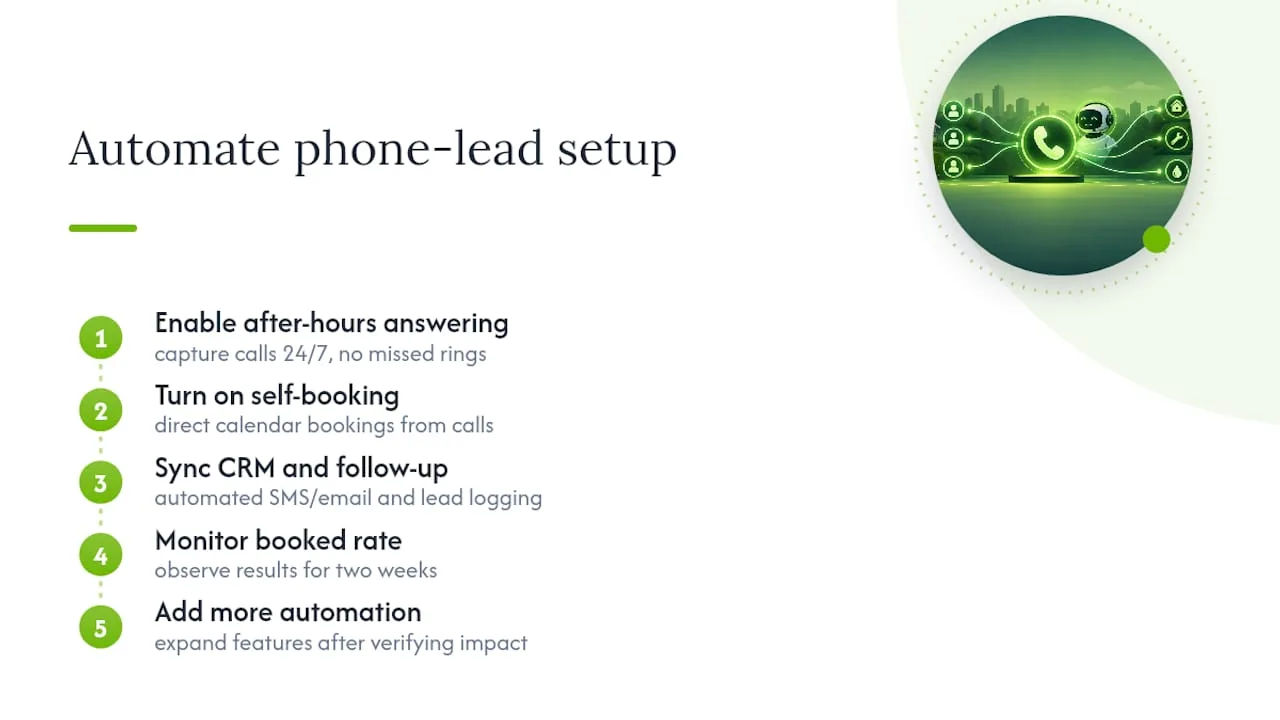
The businesses that get the most out of this approach treat it as an operations fix, not a customer-service gimmick. RingPort's model reflects that: 24/7 call answering, direct calendar booking, CRM sync, and automated SMS or email follow-up all work together so a lead captured at 9 p.m. gets the same treatment as one captured at 9 a.m. Start by turning on after-hours answering and self-booking, then watch your booked rate for two weeks before adding more automation on top.
— Serhii
RingPort: get started with a working phone lead setup
RingPort exists for exactly the problem this article covers: local service businesses that lose jobs to missed calls but can't justify a full-time receptionist. It answers every call around the clock, books directly to your calendar, syncs leads to your CRM, and follows up by text or email automatically, so a caller at midnight gets the same response as one at noon.
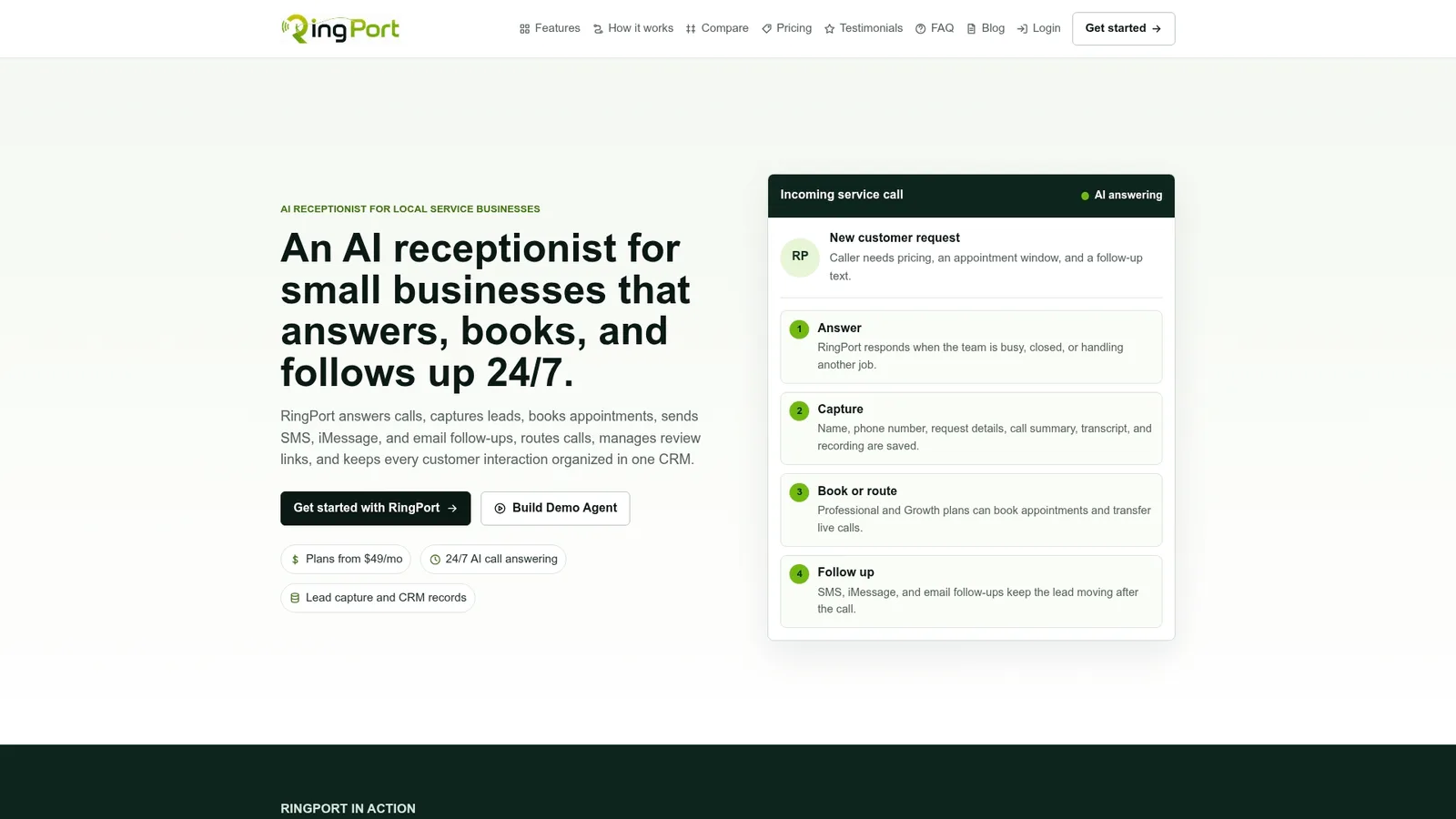
To see it in action:
- Answer calls 24/7 without adding staff or shifting your own schedule.
- Book appointments straight from the call, no callback required.
- Sync every lead to your CRM and trigger automatic SMS or email follow-up.
- Route calls with smart rules, covered in RingPort's call routing guide, so urgent jobs reach a live person fast.
Start with the Starter plan at $49 per month or explore the Professional and Growth tiers if you need higher call volume. Want to see automated answering and booking before committing? Try the RingPort Fast Agent demo. A good one-week test: turn on after-hours answering only, then compare your booked-appointment count to the same week last month.
Primary sources and further reading
For the compliance details covered above, see the FCC's declaratory ruling on AI voice calls, the Federal Register's proposed rules on AI-generated calls, and, for privacy-respecting call analytics, this guide to consentless analytics.
Sources
- FCC 24-17 Declaratory Ruling (AI and robocalls)
- Stop unwanted robocalls and texts | Federal Communications Commission
- Federal Register — Proposed rules on AI-generated calls (2024)
FAQ
Is it legal to use an AI receptionist to answer business calls?
Yes. The FCC's 2024 ruling on AI-generated voices addresses outbound telemarketing calls, not a business answering its own inbound line. Following consent and disclosure best practices for any automated follow-up keeps you clear of TCPA issues.
What information should an AI receptionist collect from callers?
Keep it to five fields: name, callback number, service requested, address or zip code, and two preferred appointment times. Fewer fields mean shorter calls and fewer hang-ups.
How fast should I follow up with a phone lead?
As fast as possible. RingPort's speed-to-lead guide treats quick first contact as one of the strongest levers for converting a new lead into a booked job.
What happens to calls I miss even with an AI receptionist?
Missed calls can be transcribed automatically through voicemail-to-text, then followed up with a text asking what the caller needs and when they're available. This keeps a missed call from becoming a lost lead.