Local Presence Dialing: A Sales Team's Guide to Higher Answer Rates
Boost your sales team's connection rates with local presence dialing. Learn effective strategies to maintain healthy caller IDs and enhance outreach.

How many customers are slipping away before you can answer?
Answer 4 quick questions and get a simple missed-call estimate for your business.
Answer with one tap. Contact details come after your result.
Here is the estimate.
Thanks. Your result was received.
Local presence dialing does increase outbound connection rates for most sales teams, often by a meaningful margin. But the effect only holds up when the numbers behind it stay healthy. Skip number rotation or reputation monitoring, and carriers will flag your local caller IDs as spam just as fast as any out-of-area number.
Here's what to do about it right away:
- Turn on local presence dialing with automatic number rotation across your dialing pool.
- Set up nightly reputation checks so a flagged number gets pulled before it tanks your morning connect rate.
Pro Tip: Local presence is a multiplier, not a fix. A rotation strategy on top of unhealthy numbers just spreads the damage across more DIDs.
Key Takeaways
Local presence dialing raises outbound answer rates reliably, but only when paired with number rotation, STIR/SHAKEN attestation, and active reputation monitoring.
| Point | Details |
|---|---|
| Local presence works, conditionally | It lifts answer rates when number health is maintained; flagged numbers erase the benefit fast. |
| Rotation prevents burnout | Size your DID pool two to three times your active count and rotate on a schedule, not reactively. |
| Attestation builds carrier trust | STIR/SHAKEN attestation and CNAM registration both improve how carriers and apps treat your calls. |
| Legal lines are clear | Area-code matching is legal; deceptive spoofing violates the Truth in Caller ID Act. |
| Capture the extra answers | Ringport routes and follows up on the live answers local presence generates so none get wasted. |
Table of Contents
- How Local Presence Dialing Works
- What Kind of Answer-Rate Lift Should You Expect?
- The Risks: Carrier Filtering, Number Reputation, and the Law
- Building a Local Presence Program That Doesn't Burn Out
- Tracking Number Health Before It Becomes a Problem
- Where an AI Receptionist Fits Into the Picture
- Local Presence or Branded Caller ID: A Quick Decision Rule
- Put the Extra Answered Calls to Work With Ringport
- Sources
How Local Presence Dialing Works
Local presence dialing matches the outbound caller ID to the area code of the person you're calling, so a Denver prospect sees a 303 number instead of your office's 800 line. The mechanics run in a specific sequence:
- Lookup: The dialer checks the destination number's area code (NPA) against a database of local rate centers.
- Pool match: The system searches your DID (direct inward dial) pool for a number in that same NPA, or a neighboring one if no exact match exists.
- CID selection: The dialer dynamically assigns that local number as the outbound caller ID for that specific call.
- Display: The receiving carrier renders the number, and where CNAM (Caller Name) data is set up, a business name label as well.
Owned number pools tend to outperform shared ones because inbound callability matters. If a prospect calls back and hits a dead line or a different business, you've burned the trust the local number just earned. STIR/SHAKEN attestation, the industry framework that verifies a caller's right to use a given number, also feeds into how much a carrier trusts that call before it even rings.
What Kind of Answer-Rate Lift Should You Expect?
The lift is real, but it's not uniform. It depends heavily on your industry, your list quality, and how well you maintain your number pool. Recent CallSphere research into AI-driven outbound calling found local presence dialing paired with strict reputation hygiene can push answer rates dramatically higher than unmanaged out-of-area calling, though the gains shrink fast once number health slips.
The behavioral driver behind this is straightforward: most Americans simply don't pick up calls from numbers they don't recognize, and an unfamiliar area code reads as one more reason to let it go to voicemail. A local number lowers that barrier before the prospect even hears a voice.
Where you'll see the biggest impact:
- Cold outreach into new territories, where an out-of-area code all but guarantees a screen.
- Appointment reminders and follow-ups, where recognition speeds up the answer.
- Field service and local trade industries, where a local number feels like a neighbor calling, not a call center.
Adding CNAM branding on top of local presence, so the phone displays your business name alongside a familiar area code, adds another layer of trust. Numbers with no CNAM data often get labeled generically by carrier apps, which quietly undercuts the local-number advantage you just paid to set up.
The Risks: Carrier Filtering, Number Reputation, and the Law
Local presence dialing fails when carriers and call-blocking apps start treating your local numbers the same way they treat robocallers. The signals that trigger filtering are well documented across the industry:
- High call velocity from a single DID in a short window.
- Short call durations, especially a pattern of calls under 15 seconds that suggests hang-ups or voicemail drops.
- Complaint reports filed through carrier apps like a Scam Likely tag.
A flagged local number is arguably worse than a plain toll-free line, because prospects who see "Scam Likely" next to a familiar area code often assume the worst kind of local scam. Once a DID earns that label, its answer rate can drop below what an unflagged out-of-area number would get.
There's also a legal line here worth drawing clearly. The Truth in Caller ID Act permits businesses to display local numbers for legitimate purposes, but it bans caller ID manipulation intended to defraud, cause harm, or wrongfully obtain something of value. Matching area codes to improve answer rates is legal. Spoofing a number you have no relationship to, or masking your identity to deceive, is not. Layer in TCPA obligations, too: local presence dialing doesn't change consent requirements for the calls themselves.
Building a Local Presence Program That Doesn't Burn Out
Getting local presence right is mostly a numbers-management problem, not a technology problem. Here's the operational sequence that keeps a program healthy:
- Size your DID pool generously. Plan for two to three times your expected active number count so you always have fresh inventory to rotate in while others rest.
- Set rotation rules. Rotate numbers on a schedule rather than reactively, and cap daily outbound calls per DID well below the volume that trips carrier filters.
- Quarantine flagged DIDs immediately. Pull any number showing complaint spikes or block flags, and let it rest rather than pushing more volume through it.
- Request CNAM registration for every active number so your business name displays, not just the area code.
- Confirm STIR/SHAKEN attestation with your provider. A-level attestation signals full verification and carries more carrier trust than partial attestation.
- Integrate a reputation API, such as those from Hiya or First Orion, to flag risk before it shows up as a dropped answer rate.
- Clean your calling lists before each campaign and respect state and federal calling-window restrictions.
Number provisioning for website and ad-based call tracking follows a similar logic to outbound dialing pools: match supply to expected volume, don't stretch one number across too much traffic.
One detail teams overlook: as answer rates climb, answering machine detection (AMD) tuning matters more, not less. A miscalibrated AMD setting that misreads a live answer as voicemail wastes the exact connection you worked to earn. Pair better AMD accuracy with automated follow-up sequencing so every live pickup routes straight to a rep or a booking flow instead of dead air.
Tracking Number Health Before It Becomes a Problem
Watch these figures on a recurring basis, ideally through an automated dashboard rather than a manual spot check:
- Answer rate by NPA (area code). A sudden drop in one region usually points to a specific flagged DID, not a company-wide issue.
- Block and complaint rates reported through carrier and app-based reputation systems.
- Percentage of calls under 15 seconds, a strong early indicator of filtering or spam mislabeling.
- AMD false-positive rate, since a rising number here means live answers are getting misrouted to voicemail handling.
Run nightly reputation checks against your active pool and quarantine anything below your risk threshold automatically rather than waiting for a manual review cycle. When you see a real drop, the fix is usually rotation first, retirement second: pull the affected DID out of rotation, submit a remediation request through the relevant caller ID registry or carrier portal, and let it rest before reintroducing it.
Where an AI Receptionist Fits Into the Picture
Local presence dialing gets you more live answers. What happens next determines whether that lift turns into revenue. Ringport's smart call routing sends those answered calls to the right rep instantly, its CRM sync logs every interaction without manual entry, and its automated follow-up sequences catch the leads who answer but aren't ready to book. With 24/7 availability, none of that connection volume goes to waste after hours either.
Local Presence or Branded Caller ID: A Quick Decision Rule
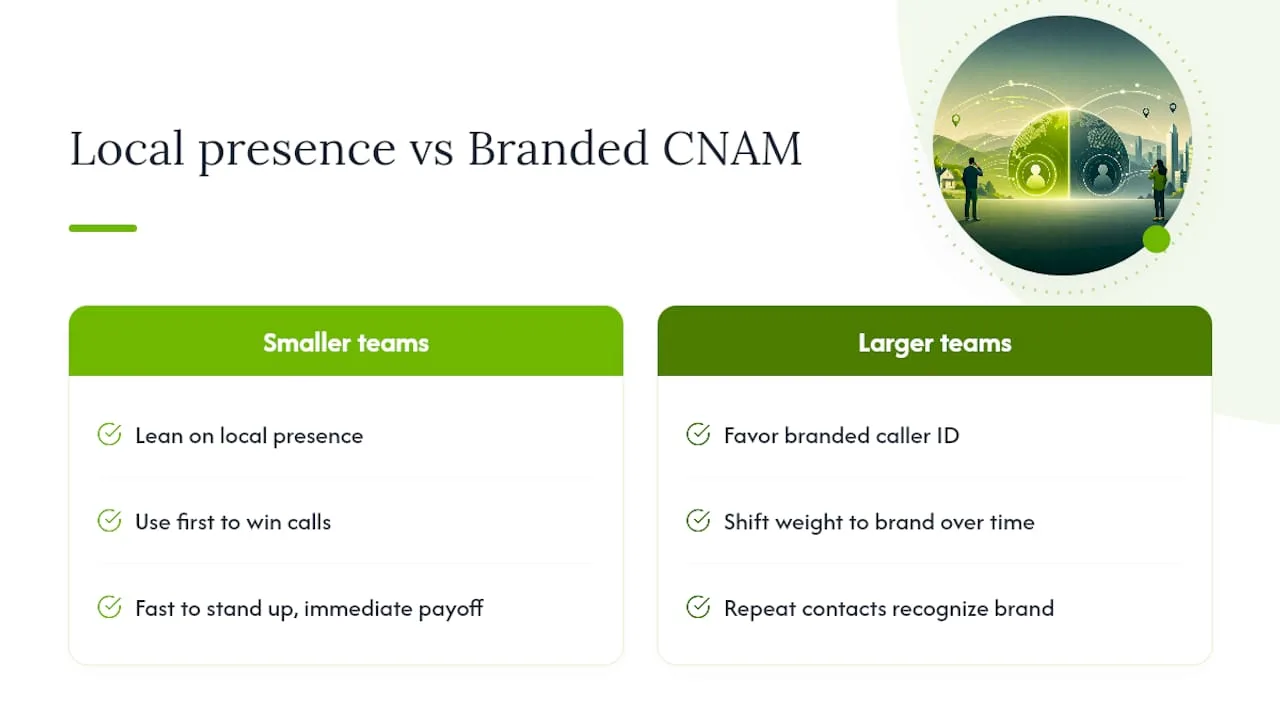
Smaller teams chasing volume should lean on local presence dialing first. It's faster to stand up and pays off immediately on cold lists. Larger teams with recognizable brand names should shift more weight toward a consistently branded caller ID over time, since repeat contacts start recognizing the business itself rather than the area code.
The sequencing that works best in practice: use local presence to win the first conversation, then build branded CNAM recognition for the relationship that follows. Most outbound teams need both, staged in that order.
— Serhii
Put the Extra Answered Calls to Work With Ringport
Ringport is the practical next step once local presence dialing starts filling your pipeline with live answers. Instead of hiring extra staff to catch overflow calls, route follow-ups, or update your CRM by hand, Ringport handles call answering, smart routing, appointment booking, and lead follow-up automatically, day or night.
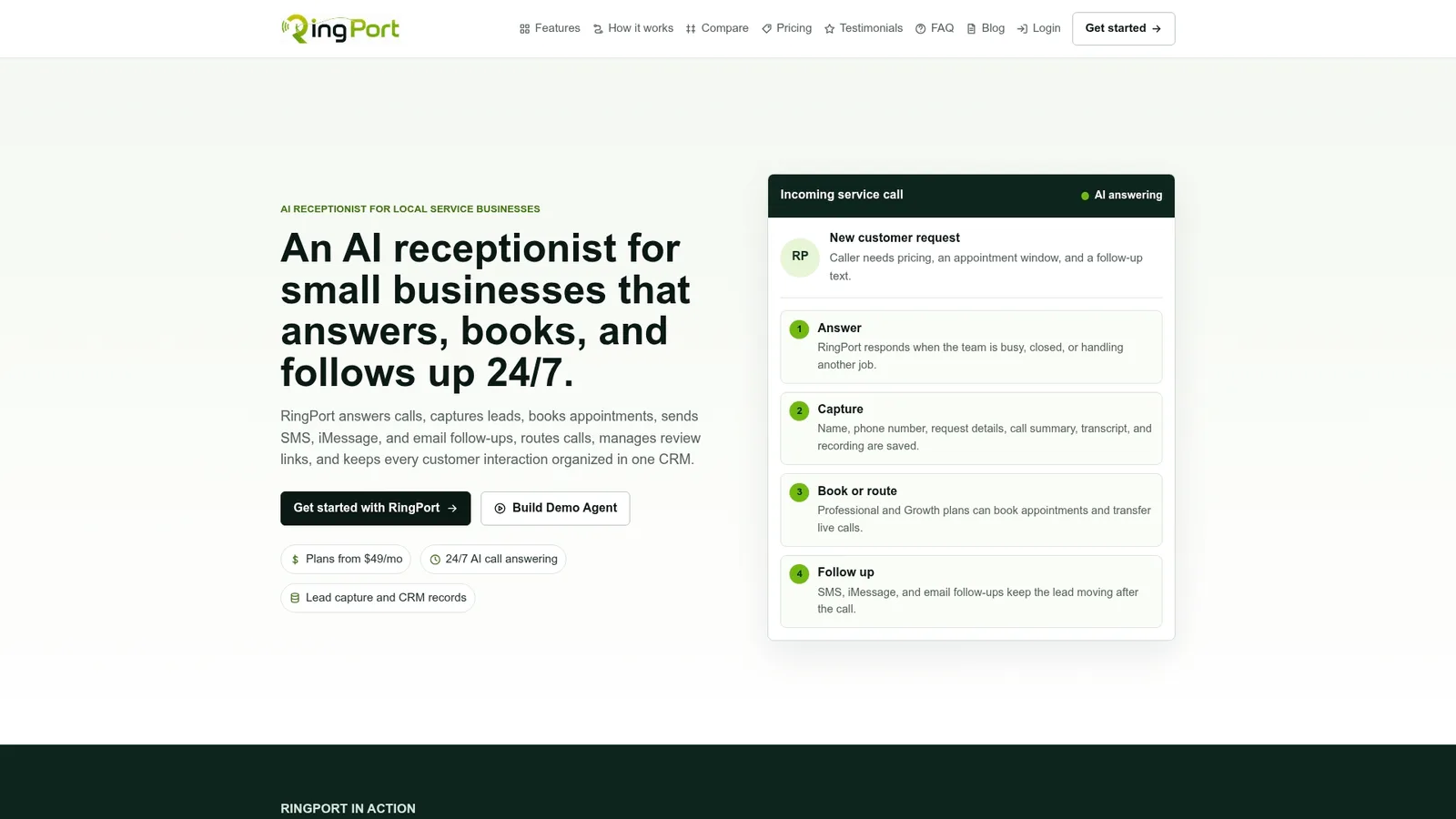
For outbound sales teams, that means every prospect who picks up because of a local number gets a fast handoff instead of a missed callback or a stale lead sitting untouched. Ringport's CRM sync keeps records current without extra data entry, and its automated SMS and email follow-ups keep warm leads moving even when your reps are on other calls. Check out the Ringport platform to see how a trial fits into your current outbound stack.
Sources
- Truth in Caller ID Act (Public Law 111-331)
- Most Americans don't answer cellphone calls from unknown numbers — Pew Research
- GeoContact — CallTrackingMetrics support article
- Geo-Routing — CallRail support article