Avoid $5,000 Penalties: U.S. Call Recording Laws for Small Businesses
U.S. guide for small and local businesses: learn state call-recording rules, use ready-to-use consent scripts, and automate verifiable consent to avoid...

How many customers are slipping away before you can answer?
Answer 4 quick questions and get a simple missed-call estimate for your business.
Answer with one tap. Contact details come after your result.
Here is the estimate.
Thanks. Your result was received.
Federal law sets a one-party consent floor for recording calls, but that floor is not the finish line. A number of states require every participant's consent, and if any caller sits in one of those all-party states, courts often apply that stricter rule to the whole conversation. The safe move for any interstate call: announce the recording and get explicit consent, every time, regardless of where you're dialing from.
TL;DR:
- When calling from a one-party consent state to an all-party consent state, the stricter law usually applies to the entire conversation.
- Most states follow either one-party or all-party consent rules, with a few hybrid states that have specific nuances for in-person versus phone recordings.
- Federal law defaults to one-party consent but does not override stricter state laws that require all-party consent, especially important in interstate calls.
- Employers monitoring employee calls need to provide clear notice and may face additional state-specific privacy restrictions beyond general recording laws.
- Using automated systems with recorded announcements and timestamped consent logs simplifies legal compliance and reduces risks of illegal recording.
Table of Contents
- What Are Call Recording Laws by State?
- How Does Federal Law Handle Interstate Call Recording?
- What Are the Rules for Recording Workplace Calls?
- How Do You Get Legally Valid Consent to Record a Call?
- What Are the Penalties for Illegal Call Recording?
- What Should a Business Call Recording Policy Include?
- How RingPort Handles Compliant Call Recording for Local Businesses
- Do Call Recording Laws Apply to International Calls?
- Are There Exceptions for Emergency Calls or Government Surveillance?
- What Recent Court Cases Are Shaping Call Recording Law?
- How Does Recording Technology Affect Legal Compliance?
- Why the Conventional Advice on Call Recording Falls Short
- Handle Compliant Call Recording Without Slowing Down Your Front Desk
- Where This Guide's Legal Information Comes From
- Sources
What Are Call Recording Laws by State?
Call recording laws split the country into three camps: one-party consent, all-party consent, and a handful of hybrid states that treat phone calls differently than in-person conversations. Getting this wrong isn't a technicality. It's the difference between a usable customer record and a felony exposure.
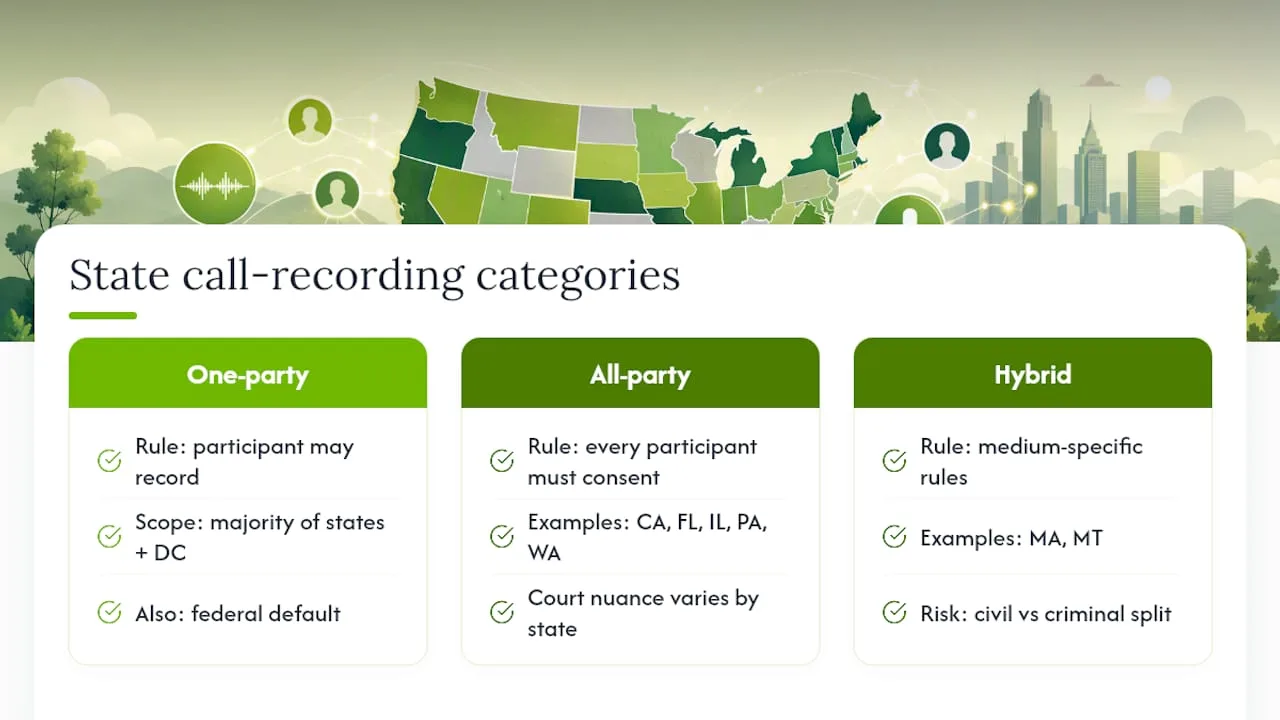
Most of the country, a majority of states plus the District of Columbia, follow one-party consent. If you're a participant in the call, you can record it without telling anyone else, because your own consent satisfies the law. That's the federal default too, and it's why most call centers and sales teams operate without a second thought about disclosure.
Some states take the opposite approach and require all-party consent, sometimes called two-party consent, though that label undersells it since some calls involve three or more people who all need to agree. According to Recording Law's 50-state survey, these states include California, Connecticut, Delaware, Florida, Illinois, Maryland, Massachusetts, Michigan, Montana, Nevada, New Hampshire, Pennsylvania, and Washington.
A few of these carry quirks worth knowing before you assume the rule is uniform. Nevada's supreme court has interpreted its statute closer to a one-party standard in some contexts, even though it's listed as all-party on most surveys, so businesses operating there often apply the stricter reading anyway to avoid a costly guess. Washington accepts a recorded announcement as a valid form of consent under its statute, which makes it more forgiving than California or Illinois, where courts generally expect a clear, affirmative response from every participant.
Then there are the hybrid states, and this is where a lot of otherwise careful businesses get tripped up. Massachusetts, for example, treats phone call interception under different standards than secretly recording an in-person conversation, and some states split criminal exposure from civil liability so that a violation might not land you in court criminally but still opens you up to a lawsuit. Montana is a useful case study here. It generally requires all-party consent for phone calls, but its rules for in-person recordings and certain business communications carry separate conditions. Treating "Montana" as a single monolithic rule, instead of checking the specific medium, is exactly the kind of shortcut that causes trouble.
If you're not sure which category your state falls into, or you're dealing with callers spread across multiple states, the practical answer is simple: treat the call as if all-party consent applies. It costs you a few extra seconds of disclosure. Guessing wrong costs a lot more.
How Does Federal Law Handle Interstate Call Recording?
The federal baseline comes from the Electronic Communications Privacy Act, specifically 18 U.S.C. § 2511, which amended the older Wiretap Act. The statute's one-party exception, found in § 2511(2)(d), lets a participant in a communication record it without the other side's knowledge, as long as the recording isn't made for a criminal or tortious purpose.
That floor sounds simple until you add a second state to the call. Federal law doesn't override a stricter state law. It just sets the minimum, and states are free to require more.
This is where interstate calls get genuinely tricky, and it's the single most misunderstood part of call recording laws by state. When a business in a one-party state calls a customer in an all-party state, whose law governs? Courts haven't settled on one uniform test. Some anchor to where the recording device physically sits. Others look at where the person being recorded is located, treating that person's expectation of privacy as the controlling factor.
The precedent that matters: In Kearney v. Salomon Smith Barney (2006), the California Supreme Court held that California's all-party consent statute applied to calls placed into California from a Georgia office, a one-party state, because the California resident's privacy interest controlled the outcome.
That decision is the reason compliance teams across the country now build policy around the strictest law touching any call, not just the law where the business is headquartered. Recording Law's guidance echoes the same conclusion: when any party to an interstate call is in an all-party state, apply that state's rule to the entire conversation.
- Federal law: one-party consent is the floor, not the ceiling
- States can and do require more
- Kearney shows courts will sometimes import a caller's home-state protections into an out-of-state call
- The conservative rule: assume all-party consent applies to any call touching more than one state
What Are the Rules for Recording Workplace Calls?
Recording a customer and recording an employee are two legally different acts, even though the mechanics look identical. Customer calls fall under the general one-party or all-party rules already covered. Employee monitoring adds a second layer: labor law, workplace privacy expectations, and sometimes a union contract that spells out exactly what an employer can and can't capture.
Employers generally have more latitude to monitor calls made on company equipment or company phone lines, especially when a written policy puts employees on notice. But "more latitude" isn't "no limits." A handful of states extend workplace-specific privacy protections that go beyond the general call recording statute, and courts have sometimes treated undisclosed employee monitoring as a separate violation from customer call recording, even in one-party states.
Union contracts frequently address monitoring directly, and ignoring that language is a fast way to trigger a grievance even when the recording itself was legal. If your workforce is organized, check the collective bargaining agreement before rolling out any new monitoring practice, not after.
Practical steps for employers:
- Put a written monitoring policy in the employee handbook and require signed acknowledgment.
- Give notice before activating call monitoring on any employee line, even in one-party states.
- Check union contracts and state-specific employee privacy statutes before expanding monitoring scope.
- Separate "quality assurance" recording policies from any covert investigative recording, which carries much higher legal risk.
How Do You Get Legally Valid Consent to Record a Call?
Consent isn't one thing. The law recognizes a few different flavors, and picking the wrong one for your situation is where a lot of businesses run into trouble.
Notice means telling someone a call may be recorded. Implied consent means the person continued the call after hearing that notice, which some courts treat as sufficient and others don't. Affirmative consent means the person actually said yes, out loud, on the recording. When you're not certain which standard your state (or the other party's state) applies, affirmative consent is the only version that holds up everywhere.
Here's how to build that into an actual call flow:
- IVR or auto-attendant script: "This call may be recorded for quality and training purposes. Press 1 to continue, or stay on the line to be transferred to an agent." Capturing the keypress or the continued connection as a timestamped event strengthens your record.
- Live agent script: "Before we get started, I want to let you know this call is being recorded. Is that okay with you?" Wait for a verbal yes and let it land on the recording itself.
- Video or online meeting announcement: "Just a heads up, I'm going to start recording this meeting now. Everyone good with that?" Most platforms follow the same wire and electronic communication rules as phone calls in most states, so treat a Zoom or Teams call exactly like you'd treat a phone call for consent purposes.
Recorded announcements alone satisfy some statutes, Washington being the clearest example, but courts in several other states expect something closer to an audible affirmative response before they'll call it valid consent. When the stakes are real, don't rely on the announcement doing the work by itself. Get the "yes."
Pro Tip: Log every consent event with a timestamp and store the recorded response separately from the main call audio. If a dispute ever surfaces months later, being able to pull the exact moment someone agreed to be recorded is worth far more than a policy document sitting in a drawer.
What Are the Penalties for Illegal Call Recording?
The financial and legal exposure here is not theoretical, and it scales fast once you're recording at volume.
On the criminal side, several all-party states classify unlawful recording as a misdemeanor for a first offense, with some statutes escalating to felony charges for repeat violations or recordings used to commit another crime. Federal exposure under 18 U.S.C. § 2511 adds criminal penalties specifically for non-participants who intercept a call they weren't part of, separate from any state charge.
Civil liability tends to hurt more in practice, because it scales with volume. California permits statutory damages of $5,000 per violation, and federal civil remedies under ECPA layer on top of whatever state damages apply. Run a call center recording thousands of customer conversations without proper consent, and a single class action can turn a training-quality initiative into a seven-figure liability.
- Criminal exposure: misdemeanor to felony, depending on the state and intent
- Civil damages: statutory amounts per violation in states like California, plus federal remedies under ECPA
- Evidentiary risk: many courts exclude illegally obtained recordings from evidence entirely, which can sink the very case the recording was meant to support
That last point matters even for businesses that never intended to litigate. An illegally recorded call can't be used to resolve a billing dispute, defend against a customer complaint, or support a wrongful termination defense, because the recording itself becomes inadmissible the moment its legality is challenged.
What Should a Business Call Recording Policy Include?
A written policy isn't paperwork for its own sake. It's the document that proves you had a system, which matters enormously if a recording practice is ever questioned in court or by a regulator.
- Draft and publish a written call-recording policy. Spell out when calls are recorded, why, who has access, and how long recordings are kept. Distribute it to every employee who handles calls, not just management.
- Set retention limits before you start recording, not after. Sixty to ninety days is a common window for general customer service calls, longer for calls tied to a specific legal or regulatory requirement. Recordings you don't need are just liability sitting on a server.
- Encrypt stored recordings and restrict access by role. Not every employee needs to hear every call. Limiting access to supervisors, compliance staff, and the specific team handling a customer's issue narrows your exposure if a breach ever happens.
- Add an IVR or live announcement to every recorded line. This should already be built into the numbered consent steps covered earlier, but it needs to be a permanent fixture, not a one-time setup task someone forgets to maintain after a system change.
- Train staff on what to do when a customer says no. Agents need a clear script for continuing the call without recording, not a scramble that makes the refusal feel awkward or, worse, gets ignored.
- Schedule a legal review any time you expand into a new state. A policy built for one-party states doesn't automatically hold up once you're taking calls from residents in Illinois or Florida.
| Compliance area | Action | Why it matters |
|---|---|---|
| Policy | Written, distributed, and acknowledged by staff | Creates a defensible record of intent and process |
| Retention | Fixed window, reviewed regularly | Reduces the volume of data at risk if something goes wrong |
| Security | Encrypted storage, role-based access | Limits exposure from internal misuse or external breach |
| Training | Scripts for consent and refusal | Keeps front-line staff consistent under pressure |
How RingPort Handles Compliant Call Recording for Local Businesses
Running a plumbing company, a med spa, or a property management office means you're answering calls constantly, and manually tracking consent on every one is a losing battle. Automated systems solve this by making the announcement and the consent capture part of the call flow itself, not an extra step someone has to remember.
An IVR or automated receptionist that plays a recording announcement, waits for an affirmative response, and logs the timestamp gives a business something a human agent often forgets under pressure: a consistent, auditable record every single time.
The trade-off businesses worry about, that adding a consent step will slow down calls or cost them leads, mostly doesn't hold up in practice. A well-designed announcement takes seconds, and callers rarely hang up over it. What actually costs businesses leads is a missed call in the first place, which is the more common failure point for small service teams.
Ringport builds this logic directly into its call handling: automated announcements, a recorded response captured on the same line, and a timestamped log tied to each interaction. For a solo owner or small team without a compliance department, that's the difference between hoping you're covered and actually being able to prove it.
Do Call Recording Laws Apply to International Calls?
Call recording laws by state stop applying the moment a call crosses a U.S. border, and that's where a lot of businesses assume the rules are similar everywhere. They're not, and in several cases, they're stricter than anything in the United States.
The European Union's General Data Protection Regulation treats call recordings as personal data, which means businesses recording calls with EU-based customers generally need a documented legal basis for processing, not just a quick verbal disclosure. Consent under GDPR has to be specific and freely given, and the bar for what counts as adequate notice is generally higher than the announcement-based consent that satisfies several U.S. states.
Canada's federal privacy framework similarly requires meaningful consent before recording most business calls, and individual provinces can layer on additional requirements the way U.S. states do. The UK, post-Brexit, largely mirrors GDPR's approach through its own data protection law.
The practical rule for any U.S. business fielding international calls: never assume your domestic one-party consent policy travels with you. If a meaningful share of your callers are outside the United States, that's a conversation for a lawyer familiar with the destination country's specific framework, not a guess based on how your business handles domestic calls.
Are There Exceptions for Emergency Calls or Government Surveillance?
Emergency service calls sit in a different legal category entirely. Calls to 911 and similar emergency lines are recorded as a matter of standard public safety practice, and callers are generally treated as having implicitly consented the moment they dial an emergency number, precisely because the recording serves the caller's own safety and the responding agency's need for an accurate record.
Government surveillance follows its own separate framework, governed primarily by the Foreign Intelligence Surveillance Act and Title III of the Wiretap Act rather than the state-level consent rules covered throughout this guide. Law enforcement generally needs a warrant to intercept private communications, though exceptions exist for national security investigations and specific emergency circumstances defined in federal statute.
Neither of these categories offers a template a private business can borrow. A landscaping company can't claim an "emergency exception" to skip consent on a customer call, and a debt collector can't invoke national security statutes to justify recording without disclosure. These carve-outs exist for narrow public functions, not general business convenience, and courts have consistently declined to stretch them to cover ordinary commercial recording.
What Recent Court Cases Are Shaping Call Recording Law?
Kearney v. Salomon Smith Barney remains the case every compliance team eventually runs into, and it's still the clearest illustration of how a California resident's presence on a call can pull the entire conversation under California's all-party rule, regardless of where the other party sat. That 2006 decision continues to shape how courts and compliance teams approach interstate calls today.
More recent litigation trends have focused less on phone calls specifically and more on how the same consent principles extend to newer communication channels: video conferencing platforms, in-app voice features, and automated dialing systems that record without a clear human decision point at the moment of capture. Courts have generally applied the same wire and electronic communication framework to these newer formats rather than carving out separate rules, which means the Kearney logic and the underlying all-party statutes still control the outcome even when the technology looks nothing like a traditional phone call.
The trend line across recent cases points in one direction: courts are not creating new leniency for new technology. If anything, plaintiffs' attorneys have gotten more aggressive about applying decades-old consent statutes to modern call and meeting platforms, which is exactly why a conservative, disclosure-first policy matters more now than it did when most of these laws were first written.
How Does Recording Technology Affect Legal Compliance?
The method you use to record a call doesn't change the underlying consent requirement, but it changes how easily you can prove you followed it, and that distinction matters more than most businesses realize until they're staring at a dispute.
A basic phone system that records everything by default, with no announcement and no consent log, gives you a recording but no proof of lawful capture. If a customer disputes consent later, you have audio and nothing else to back up how it was obtained.
An IVR-based system that plays a recorded announcement, waits for a keypress or verbal response, and timestamps that response alongside the call recording gives you both the audio and the evidentiary trail. That trail is what actually matters if a recording's legality is ever challenged, because the law cares less about whether you recorded the call than about whether you can demonstrate the other party agreed to it.

Cloud-based and AI-driven call platforms have made this easier to standardize, since the consent step becomes a fixed part of the call flow rather than something a busy front desk employee has to remember on the fly. The trade-off is that businesses need to configure these systems correctly from day one, because a misconfigured IVR that skips the announcement step creates the exact same exposure as a system with no consent process at all.
Why the Conventional Advice on Call Recording Falls Short
Most guidance on call recording laws by state treats the map as the whole answer: find your state, check the box, move on. That's incomplete, and it leaves businesses exposed the moment a call crosses a state line, which happens constantly for any company that takes calls from more than one region.
The bigger gap is operational, not legal. Businesses know they need consent in principle but don't build a system that actually captures it reliably, call after call, without relying on a human to remember every time. That's where most real-world violations come from: not malice, just inconsistency.
If you're a small business owner reading this looking for the one thing to fix first, it's not memorizing which of the thirteen all-party states you might talk to. It's building a recording process where the announcement and the consent capture happen automatically, every single call, so compliance doesn't depend on anyone's memory on a busy Tuesday. Get that system right, and the state-by-state nuance becomes far less dangerous.
— Serhii
Handle Compliant Call Recording Without Slowing Down Your Front Desk
Building a manual consent process into every call is exactly the kind of task that gets skipped the moment your team gets busy, and busy is the normal state for most local service businesses. Ringport is built to make that step automatic instead of optional. Every call gets a consistent recorded announcement, a logged response, and encrypted storage, without your front desk having to remember a script.
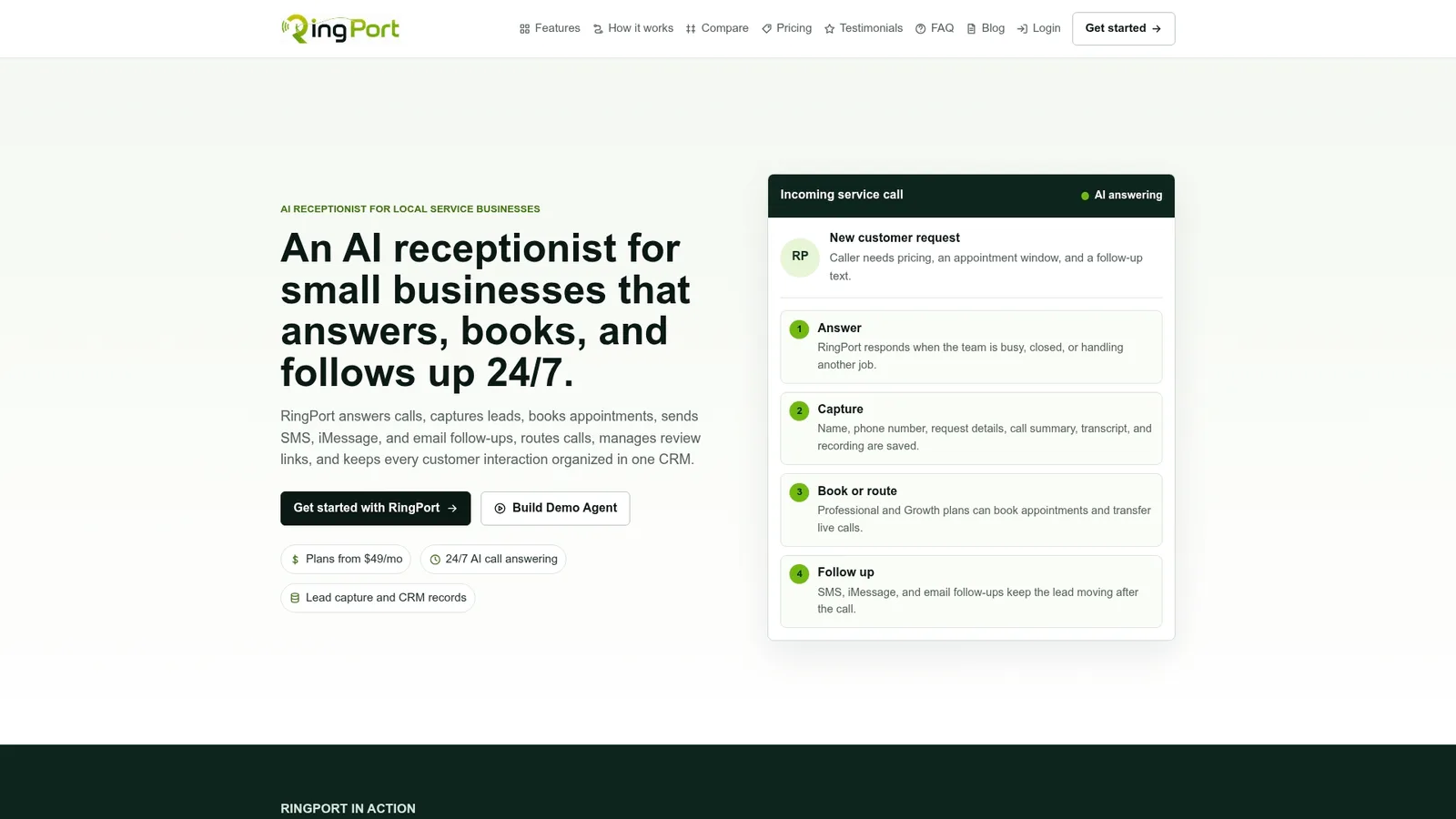
Beyond the compliance piece, Ringport answers calls 24/7, books appointments directly into your calendar, and routes urgent calls to the right person, so the same system that protects you legally also stops you from losing leads to a missed call. Feature bullets worth knowing: automated consent announcements, one-tap record toggles, timestamped consent logs, encrypted storage, and appointment booking that runs whether you're on another job or asleep.
If you're a home services company, a salon, or a medical office juggling calls and compliance at the same time, see how Ringport works and start a trial to see your first recorded, compliant call handled automatically.
Where This Guide's Legal Information Comes From
This guide draws its statutory framework and state classifications from primary and authoritative legal sources, cross-checked against each other rather than pulled from a single survey.
- 18 U.S.C. § 2511 — the federal statute establishing one-party consent under ECPA
- Recording Law's 50-state survey — state-by-state classification of one-party, all-party, and hybrid jurisdictions
- Justia's 50-state survey on recording phone calls — comparative legal summaries across states
- Reporters Committee for Freedom of the Press's Reporter's Recording Guide — newsgathering-focused state law summaries
Laws referenced here reflect statutes and case law current as of 2026. State legislatures amend recording statutes periodically, so businesses operating in high-risk, all-party states should confirm current requirements with a licensed attorney, and consider a resource like Landlord Compliance's consultation booking page for related compliance policy work.
Sources
- 18 U.S.C. § 2511 — Interception and disclosure of wire, oral, or electronic communications
- US Recording Laws by State (2026): All 50 States Explained | Recording Law
- Recording Phone Calls and Conversations Under the Law: 50-State Survey | Justia
- Reporter's Recording Guide | Reporters Committee for Freedom of the Press
- U.S. Code, Title 18, Chapter 119 — Interception and disclosure of wire, oral, or electronic communications