
PMS Integrated Call Handling for Property Teams, 2–4 Week Pilot
Choose a PMS integrated call handling solution that proves emergency triage and SLA performance. Run a 2–4 week pilot before you commit.

How many customers are slipping away before you can answer?
Answer 4 quick questions and get a simple missed-call estimate for your business.
Answer with one tap. Contact details come after your result.
Here is the estimate.
Thanks. Your result was received.
If you manage more than a handful of units or need reliable after-hours coverage, professional call handling (or an AI receptionist) is the fastest way to stop missing leads and slow emergency responses. The right fit depends on three filters: whether the provider triages emergencies correctly, whether it writes directly into your property management software, and whether it can prove response times with real reporting. Start with a two to four week pilot before signing anything longer.
TL;DR:
- AI receptionists and specialized call centers can triage emergencies accurately using explicit protocols and escalate critical issues within minutes, unlike generic answering services.
- Direct integration with property management software and structured data intake fields reduce manual transfer errors and improve response times for maintenance and leasing inquiries.
- Service level agreements should specify response times under 20 seconds for answer, under five minutes for emergency escalation, and low abandonment rates to ensure reliable call handling.
- Vendors should demonstrate real PMS integration, emergency triage clarity, and compliance with Fair Housing laws during demos and pilot tests before long-term commitments.
- Affordable AI call handling plans start at $49 monthly, providing 24/7 coverage, smart routing, lead capture, and reporting, offering a cost-effective alternative to traditional phone services.
Table of Contents
- What Does Property Management Call Handling Actually Cover?
- What Features and Integrations Should You Require?
- What SLAs and Reporting Should You Require?
- How Do You Choose the Right Call Handling Provider?
- Rolling Out Call Handling Without Breaking Your Workflow
- Why AI Reception Is Changing Property Management Call Support
- An Editor's Take on When Call Handling Actually Pays Off
- Try Ringport Before You Sign a Long-Term Answering Contract
- Sources
- FAQ
What Does Property Management Call Handling Actually Cover?
Property management call handling means routing tenant, owner, and prospect calls to a team or system built to triage, log, and act on them without a property manager picking up every ring. That can mean a live answering service, a specialist call center built for the industry, or an AI receptionist that answers instantly and escalates only what needs a human. Each model solves the same core problem differently, and the differences matter more than most vendor pitches let on.
A property management call center functions as an extension of your team. It handles inbound calls, triages maintenance emergencies, dispatches vendors, and creates work orders directly inside your property management software. That last part, direct work order creation, is what separates a real operational partner from a glorified voicemail box.
Generic answering services pick up the phone and take a message. They're cheap and fast to set up, but they rarely understand the difference between "my sink is dripping" and "there's water coming through my ceiling." Specialist property management call centers train operators on your specific escalation rules and property portfolio. AI receptionists split the difference: instant pickup, scripted logic for triage, and the ability to escalate a genuine emergency to a live human within seconds rather than minutes.
Here's how the three models typically handle the calls that matter most:
-
Leasing inquiries: All three models can capture basic details, but AI receptionists and call centers usually book tours or send application links automatically, while a generic answering service just relays a message.
-
Maintenance requests: Specialist centers and AI receptionists distinguish routine repairs from emergencies using scripted criteria; generic services often can't tell the two apart.
-
Billing questions: These get routed to office staff or a portal link in most setups, since payment details usually require account-specific verification.
-
Owner calls: Higher-touch models flag owner calls for priority callback rather than treating them like any other tenant inquiry.
-
HOA and board communications: These calls often need documentation and follow-up tracking, which favors providers with strong logging and reporting.
Coverage models split into three practical tiers. Full 24/7 coverage suits portfolios with maintenance emergencies at any hour, think multifamily buildings with plumbing, heating, or lockout issues. After-hours only coverage works for smaller portfolios where daytime staff can handle most calls and only need backup evenings and weekends. Overflow coverage, where the service only picks up when your line is busy or unanswered after a set number of rings, fits teams that want a safety net without full outsourcing.
The staffing trade-off is straightforward: the more hours you outsource, the less burnout risk your team carries, but the more you depend on a vendor's training quality. A property manager fielding 2 AM calls about a broken furnace every winter is not doing their best work at 9 AM the next day.
What Features and Integrations Should You Require?
Not every call handling vendor deserves your business, and the features that separate a genuine operational upgrade from an expensive answering machine are specific and checkable.
1. Direct PMS integration, not just call logs. The single biggest differentiator among vendors is whether they can write work orders directly into your property management software, whether that's Buildium, AppFolio, or Yardi. Without direct write-in, your staff spends hours every week transferring notes manually, and that gap is where errors and delayed maintenance responses happen. Ask for a live integration demo before you sign anything.
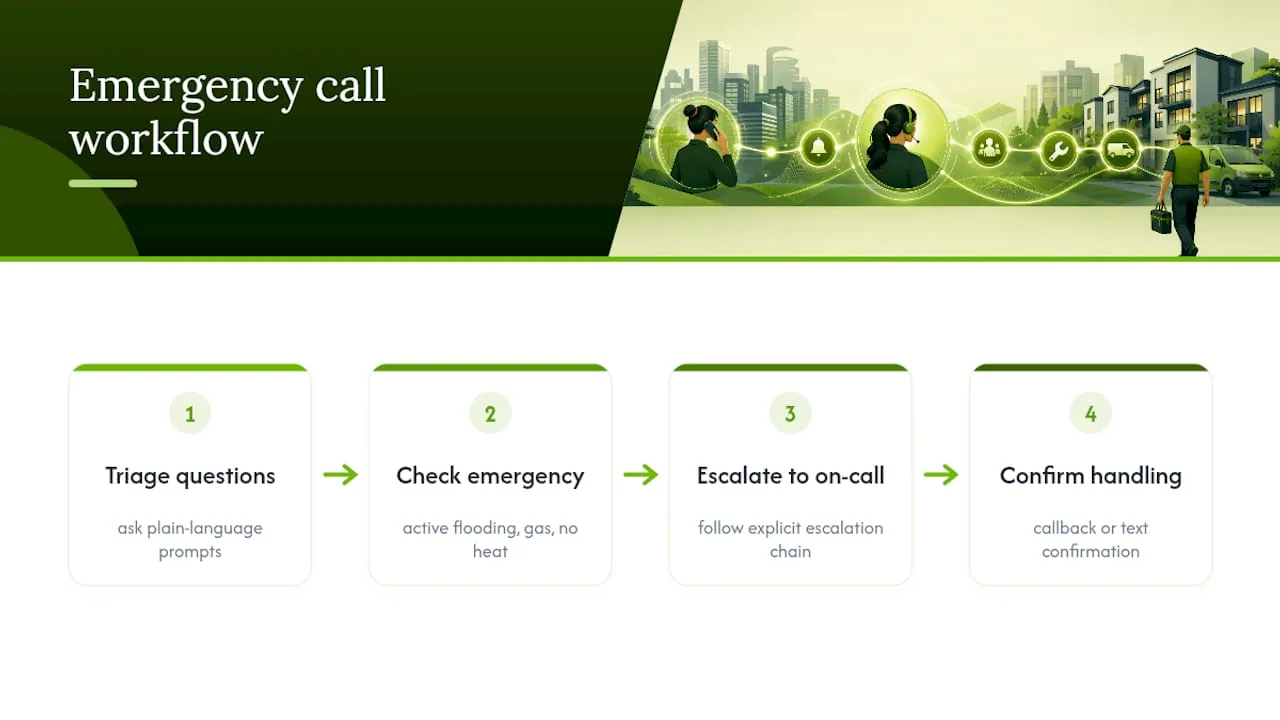
2. Emergency triage workflows with confirmation protocols. A good vendor asks specific, plain-language questions to determine whether a call is a true emergency (active flooding, gas smell, no heat in winter) or a routine request that can wait until business hours. Operators should follow explicit escalation chains so a genuine emergency reaches on-call staff immediately rather than sitting in a voicemail queue. Confirmation matters too: emergencies should trigger a callback or text confirmation so nothing gets lost between "logged" and "handled."
3. Structured intake fields on every call. Scripts should capture a consistent, minimal set of fields on every call: caller name, property or unit number, reason for the call, urgency level, and a callback number. That short list reduces follow-up calls and creates a traceable record you can audit later.
4. Clear data handoff mechanics. Ask exactly how call data reaches your systems. API integration and webhooks are the gold standard because they push data instantly without manual steps. Direct manual entry into a shared portal is the fallback, but it introduces delay and human error. Whatever method the vendor uses, ask how they encrypt call recordings and tenant data at rest and in transit, and who has access to that data internally.
5. Fair Housing compliant scripting. Call intake must treat every caller equally and avoid discriminatory screening questions, a requirement spelled out clearly in Fair Housing Act guidance from the Department of Justice. Any vendor script that asks leasing prospects about family status, national origin, or similar protected characteristics is a legal liability waiting to surface.
Pro Tip: Ask a prospective vendor to walk you through their exact emergency criteria in plain language, not marketing copy. If they can't name three or four specific triggers, like "active water leak" or "no heat below 40 degrees," on the spot, their triage training probably isn't as rigorous as their sales deck suggests.
What SLAs and Reporting Should You Require?
Contracts without measurable service standards are just hope dressed up as a business agreement. Before signing with any provider, get specific numbers written into the contract, not vague promises about "fast response."
The service level agreements worth requesting include:
- Average speed to answer, typically under 20 seconds for a live team and near instant for an AI receptionist.
- First-call resolution rate, the percentage of calls closed out without a callback or escalation loop.
- Emergency escalation time, how fast a flagged emergency reaches an on-call human, ideally under five minutes.
- Abandonment rate, the percentage of callers who hang up before reaching anyone, a number that should stay in the low single digits.
- Work order accuracy, how often logged details match what actually happened on-site, which tells you whether intake scripts are doing their job.
Smart routing and automated intake genuinely move these numbers. Routing calls to the right person automatically, rather than making callers navigate a menu or wait on hold, measurably improves first-call resolution and cuts wait time, since callers reach someone who can actually help on the first try instead of bouncing between departments.
Reporting frequency matters as much as the metrics themselves. Insist on a live dashboard for real-time visibility plus a monthly written report that breaks down call volume by category (leasing, maintenance, billing, emergency), average response times, and any escalations that required manager involvement. A vendor unwilling to commit to monthly reporting in writing is signaling they don't want you checking their work.
Benchmarks differ by portfolio size. A small portfolio under 50 units can often get by with overflow coverage and a lighter reporting cadence, maybe quarterly reviews instead of monthly. Mid-size and larger portfolios, especially anything with 24/7 emergency exposure, should insist on monthly reporting minimum and contract clauses specifying penalties or credits if SLAs are missed for two consecutive months. Build an exit clause with 30 to 60 days' notice into any contract longer than six months, so a bad fit doesn't lock you in for a year.
How Do You Choose the Right Call Handling Provider?
Evaluating vendors gets a lot easier when you treat it as a structured process instead of a series of sales calls where everyone sounds equally confident.
- List your call volume and peak hours first. You can't evaluate a vendor's capacity claims without knowing your own baseline, so pull three months of call logs if you have them.
- Shortlist three vendors that match your coverage need. Don't waste time on providers built for industries outside property management. Their scripts and escalation logic won't translate.
- Request a live integration demo with your actual PMS. Watching a vendor create a real work order in Buildium or AppFolio in real time tells you more than any feature list.
- Ask for two or three specific escalation examples. A vendor should be able to describe an actual emergency call, how it was triaged, and how fast it reached a human, without vague generalities.
- Ask how they run quality assurance. Sample-based QA and scripted role-play during onboarding are strong predictors of consistent service and help enforce compliant, non-discriminatory call handling over time.
- Design a pilot before committing long-term. A well-run pilot runs two to four weeks and tracks emergency response verification and lead conversion, not vanity metrics like total call volume.
- Compare pricing models against your actual usage. Flat monthly fees work for predictable volume; per-minute or tiered usage plans fit portfolios with seasonal spikes.
Red flags that justify walking away include vendors who can't produce a live integration demo, anyone reluctant to commit to written SLAs, scripts that ask about protected characteristics, and any provider who treats "we log everything" as a substitute for direct PMS write-in.
Pro Tip: During your pilot, call the emergency line yourself, after hours, pretending to be a tenant with a burst pipe. If the operator or AI can't triage that in under a minute, no dashboard metric later will fix the gap you just heard firsthand.
Rolling Out Call Handling Without Breaking Your Workflow
Getting a new call handling system live takes more than flipping a switch, but it shouldn't take months either.
Start onboarding by mapping every property in your portfolio along with authorized contacts for each: property managers, maintenance vendors, and on-call staff for emergencies. The vendor needs this list before day one, not week three. Provide property-specific details too, gate codes, shutoff valve locations, preferred vendor contacts, because generic scripts fail the moment a caller asks something specific to their building.
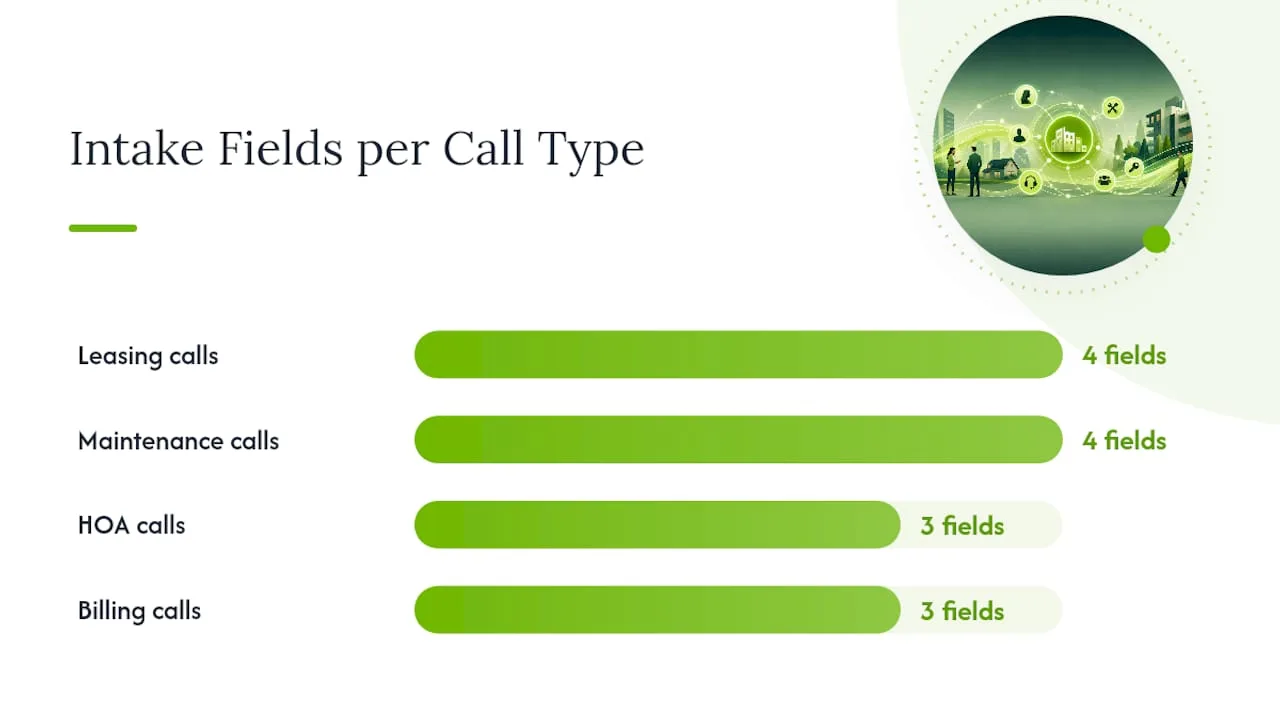
Sample intake fields should stay consistent across call types, even as the script branches:
- Leasing calls: name, unit interest, move-in timeline, contact info.
- Maintenance calls: unit number, issue description, urgency level, access instructions.
- HOA calls: board member status, issue category, documentation needed.
- Billing calls: account number, nature of the question, callback preference.
Short scripts work better than long ones. A maintenance call script might run: "Can you describe what's happening? Is there active water, smoke, or a safety concern right now? What's the best number to reach you if we need more details?" That's three questions, and it captures everything needed for triage.
Handoff mechanics determine whether your team trusts the system. Calls should convert into work orders automatically through PMS integration, with confirmation texts or emails sent to both the tenant and the assigned technician. If a vendor's process ends with "we'll email you the notes," that's a manual step waiting to create a delay.
Set a QA cadence from day one: weekly call reviews for the first month, then monthly spot checks once the system stabilizes. Onboarding and operator training are strong predictors of service quality, and regular script refreshes catch drift before it becomes a pattern of missed emergencies or compliance slip-ups.
Why AI Reception Is Changing Property Management Call Support
AI reception isn't replacing human judgment in property management, it's replacing the missed call. The gap most portfolios bleed leads and goodwill through isn't bad staff, it's the 11 PM call nobody answers or the leasing inquiry that goes to voicemail during a Saturday showing.
An AI receptionist like Ringport picks up instantly, every time, and applies the same triage logic a trained operator would use: separating a genuine emergency from a routine request, capturing the right intake fields, and deciding whether to resolve the call automatically or escalate to a human. Hybrid flows that collect details, qualify the caller, then warm-transfer to on-call staff when needed cut down on missed-lead loss significantly during after-hours windows, when most property management teams have zero live coverage.
An AI receptionist's approach typically centers on automated call answering paired with smart routing, CRM management, and 24/7 lead capture, so a tenant maintenance call and a prospective renter's inquiry get handled the moment they come in, not whenever someone checks messages the next morning.
The real test of any AI receptionist isn't how well it handles a normal Tuesday afternoon call. It's whether it correctly flags a burst pipe at 2 AM and gets a real person on the phone within minutes, not hours.
This doesn't mean AI replaces your leasing agents or maintenance coordinators. It means the phone gets answered before a caller gives up and calls a competitor, or worse, before a maintenance issue turns into a habitability complaint because nobody picked up.
An Editor's Take on When Call Handling Actually Pays Off
Most property managers wait too long to outsource call handling because they're measuring the wrong thing. They track total call volume when they should be tracking missed calls after hours and how many leasing inquiries go cold before anyone calls back. If you're losing even a few leads a month to unanswered calls, a pilot pays for itself fast.
Fair Housing compliance isn't optional in any script your vendor uses, and it's worth a quick conversation with legal counsel before you finalize intake questions, especially around screening language.
If you're ready to test this instead of debating it further, a short Ringport pilot will tell you more in two weeks than another month of research will.
— Serhii
Try Ringport Before You Sign a Long-Term Answering Contract
An AI receptionist service can be the alternative to hiring a full-time receptionist or locking into a long answering-service contract: offering 24/7 automated call answering, smart routing, and CRM management that plugs into your existing workflow without adding headcount.
[Image illustrating call handling service plans]
Every plan is built for teams that need reliable phone coverage without the overhead of a full front-desk hire. The Starter plan runs $49 per month, Professional is $149 per month, and Growth is $299 per month, each scaled for different call volumes, with pay-as-you-go add-ons available if you need extra minutes during a busy leasing season. Ringport handles the intake, captures leasing leads around the clock, and routes emergencies to the right person instead of leaving tenants on hold. If you're comparing this against a traditional call center or generic answering service, the practical difference is speed of setup and cost predictability, no contracts to negotiate, no seats to staff.
Start a free trial or book a live demo at Ringport to see how fast you can get a pilot running on your own portfolio.
Sources
For readers who want to go straight to the primary sources behind the standards in this guide:
- Property Management Call Center Guide | Buildium
- Fair Housing Act overview | U.S. Department of Justice
FAQ
What Does the 80/20 Rule Mean in Property Management?
The 80/20 rule in property management generally refers to the idea that 80% of your problems, complaints, or maintenance issues come from 20% of your units or tenants. It's a prioritization principle, not a fixed statistic, and it's often used to justify focusing call handling resources and follow-up attention on the properties or tenants generating the most recurring issues.
What Are Property Managers Not Allowed to Do?
Property managers can't discriminate against tenants or applicants based on protected characteristics like race, religion, national origin, familial status, or disability, under the Fair Housing Act. This extends directly to phone call handling: screening questions, leasing scripts, and intake logic all have to treat every caller the same way regardless of who's asking.
What Is the Biggest Responsibility for Property Managers?
The biggest responsibility for property managers is maintaining habitable, safe living conditions while managing consistent communication with tenants and owners. Call handling ties directly into this because a missed emergency call, like a gas leak or a burst pipe, can turn into a habitability or liability issue within hours if it isn't triaged and escalated correctly.
What Should You Do When a Property Manager Doesn't Respond?
If a property manager isn't responding to maintenance or leasing calls, document every attempt to reach them with dates and times, then escalate to the property owner, management company, or a local tenant rights office if the issue is urgent. This exact scenario is what professional call handling and AI receptionists like Ringport are built to prevent, since every call gets an immediate response and a logged record instead of an unanswered voicemail.
How Much Does Property Management Call Handling Cost?
Costs vary by provider and coverage model, but Ringport's plans run from $49 per month for Starter, $149 for Professional, up to $299 for Growth, with pay-as-you-go options for extra call volume. Traditional live answering services and specialist call centers typically charge per minute or per call, which can cost more for high-volume portfolios than a flat-rate AI receptionist plan.