
One Page SMS Business Etiquette: Compliance, Templates, Opt Out Rules
A one page, compliance focused SMS etiquette checklist for busy teams. Includes templates with required opt out wording, timing rules, consent logging,...

How many customers are slipping away before you can answer?
Answer 4 quick questions and get a simple missed-call estimate for your business.
Answer with one tap. Contact details come after your result.
Here is the estimate.
Thanks. Your result was received.
Good SMS business etiquette comes down to three habits: ask permission before you text, send only between reasonable hours, and always give people a clear way to opt out. Get those right and you avoid the biggest legal and relationship risks, from TCPA violations to customers who mute your number for good. The rest of this guide breaks down exactly how to apply those habits, with templates and a policy checklist that your team can put to use today.
TL;DR:
- Sending promotional texts more than twice a week risks overwhelming customers and increasing opt-out rates, especially if they have not explicitly requested such frequency.
- Using SMS for sensitive data such as medical or financial information is risky, as it lacks the secure encryption required for confidential disclosures.
- Texts sent outside of the defined 8 AM to 9 PM local window can be perceived as intrusive, leading to negative customer perception.
- Avoid merging multiple topics in one message to prevent confusion and ensure each message has a clear, singular purpose.
- Implementing automated opt-out and response handling through tools like RingPort ensures compliance and maintains consistent, professional communication.
Table of Contents
- 1. Essential dos and don'ts for business texts
- 2. Consent and compliance: what to follow
- 3. Timing, frequency, and follow-up cadence
- 4. Tone, wording, and formatting that read as professional
- 5. Appropriate use cases and when to choose a different channel
- 6. Ready-to-use templates and micro-examples
- 7. How to implement an SMS etiquette policy for your team
- 8. Privacy concerns for group texts and sharing numbers
- 9. Cultural differences in SMS etiquette
- 10. Impact of SMS etiquette on brand reputation and customer trust
- 11. Common SMS etiquette mistakes to avoid
- 12. Legal implications beyond TCPA and FCC rules
- 13. Author perspective and practical tradeoffs
- 14. How RingPort supports compliant, templated SMS follow-up
- 15. Primary sources and further reading
- Sources
- FAQ
1. Essential dos and don'ts for business texts
Before you send another business text, run it against this checklist. It covers the habits that protect your customer relationships and keep your number in good standing with carriers.
- Do get consent first: a customer who gave their number for one purpose has not automatically agreed to texts for another.
- Do identify your business by name in the first message, since an unrecognized number gets ignored or reported as spam.
- Do include opt-out instructions such as "Reply STOP to unsubscribe" in your opening text and any recurring campaign.
- Do stick to one topic per message. A text asking about an appointment and mentioning a new promotion reads as confusing, not efficient.
- Don't text outside normal waking hours. A message that lands at 11 PM feels intrusive no matter how useful the content is.
- Don't send sensitive information like account numbers, medical details, or payment data over SMS.
- Don't send multiple follow-ups in a single day or lean on stacked emoji and exclamation points to fill space.
Pro Tip: Test every new template on a small internal group before it goes to customers. Reading a message out loud catches awkward phrasing faster than reading it silently.
2. Consent and compliance: what to follow
Texting customers without the right consent is the fastest way to rack up complaints and legal exposure. FCC and TCPA rules require prior express written consent for most marketing texts, and recent updates have made it easier for consumers to revoke that consent at any time. Transactional messages, like an appointment reminder tied to a service the customer already booked, generally fall under a looser implied-consent standard, but the safest approach treats every recurring text program as if it needs documented opt-in.
- Capture consent at the point of signup with plain language explaining what the customer will receive and how often.
- Store the timestamp and source of that consent, and log any opt-out request against the same customer record.
- Follow CTIA messaging guidance by identifying your business, including standard opt-out wording, and disclosing expected message frequency for any recurring program.
- Honor STOP and HELP replies immediately. Carriers watch response times and can filter or block numbers that lag.
Keeping a simple audit trail of consent and revocations matters as much as the technical compliance itself. If a complaint ever surfaces, that record is what protects you.
3. Timing, frequency, and follow-up cadence
Timing mistakes are some of the easiest to avoid and the most common. A default window of 8 AM to 9 PM in the recipient's local time zone keeps messages within normal waking hours, and going outside it should require a specific reason, like a same-day appointment change.
For promotional messages, a cadence of one to two texts per week is a reasonable benchmark unless the customer has asked for more frequent updates. Transactional texts, like a confirmation or a reminder, follow the pace of the underlying appointment or order instead of a fixed weekly rhythm.
- Default sending window: 8 AM to 9 PM in the customer's own time zone, not yours.
- Promotional cap: one to two messages per week unless the customer opts into more.
- Follow-up rule: send one reminder after a reasonable gap, then stop and switch channels if there's no response.
- Track opt-out rates by campaign. A spike usually means the cadence or timing needs adjusting, not the offer itself.
4. Tone, wording, and formatting that read as professional
A text message has no tone of voice, no facial expression, and no body language to soften it, so the words alone carry all the meaning. Because texting lacks nonverbal cues, clear, complete sentences matter more here than in a casual conversation, not less.
Keep every message to one screen and one topic, with a single clear action for the recipient to take, whether that's confirming a time or clicking a link. Write in full sentences rather than clipped fragments, skip ALL CAPS, and use at most one emoji if it genuinely fits the message. Always name your business in the opening text and repeat the opt-out line on any recurring send.
- Lead with the point: "Hi, this is [Business Name] confirming your appointment for Tuesday at 2 PM."
- End with one clear next step: "Reply YES to confirm or call us to reschedule."
- Avoid ambiguity that could read as curt. "Confirmed." alone can feel abrupt; "You're confirmed for 2 PM, see you then!" reads warmer.
Pro Tip: Save your approved templates in a shared document so every team member sends the same polished wording instead of improvising each time.
5. Appropriate use cases and when to choose a different channel
SMS earns its place in a business's communication mix by being fast and low friction, but that same brevity makes it the wrong tool for anything that needs nuance or documentation.
- Use SMS for appointment confirmations, reminders, and quick logistics like "running 10 minutes late."
- Use SMS for brief status updates that need no explanation, such as "your order has shipped."
- Avoid SMS for sensitive personal data, detailed billing disputes, or any regulated disclosure that needs a paper trail.
- Avoid SMS for long negotiations or anything requiring back-and-forth clarification, since texting's brevity invites misreading.
- Escalate to a phone call when the topic involves pricing negotiation, a complaint, or anything emotionally charged.
- Escalate to secure email when you need to share documents, contracts, or account-specific details.
Internal team texting can be looser than customer-facing texting, but the same one-topic rule still keeps threads readable.
6. Ready-to-use templates and micro-examples
These short templates cover the scenarios most small businesses hit every week. Swap in your business name, the customer's details, and your opt-out line, and keep the tone from the examples above.
- Opt-in capture: "Hi, this is [Business Name]. Reply YES to get appointment reminders by text. Msg & data rates may apply. Reply STOP to cancel."
- Confirmation: "You're confirmed with [Business Name] for [service] on [date] at [time]. Reply STOP to opt out."
- Reminder: "Reminder: your appointment with [Business Name] is tomorrow at [time]. Reply YES to confirm."
- Reschedule: "Hi [Name], we need to move your appointment to [new time]. Does that work? Reply STOP to opt out."
- Follow-up: "Just checking in: are you still interested in [service]? No pressure, reply STOP anytime."
Insert a booking link or contact number where relevant, and test any new template on a handful of real customers before rolling it out broadly.
7. How to implement an SMS etiquette policy for your team
A written policy only works if it fits on one page. Anything longer gets skimmed once and ignored.
- Define who is allowed to text customers and under what circumstances, so casual texting doesn't creep into unrelated departments.
- Set approved sending hours and require every recurring program to log its consent source and timestamp.
- Assign one person or team to own opt-out and HELP handling, since automating STOP and HELP responses protects deliverability and reduces complaints.
- Require sign-off on any new template before it goes live, using the same checklist from earlier sections.
- Keep a simple log of consent, opt-outs, and complaints that anyone on the team can audit.
Pro Tip: Review your templates every quarter. Wording that felt natural six months ago can start to sound stale once customers have seen it a dozen times.
8. Privacy concerns for group texts and sharing numbers
Group texts create a privacy problem that single sends don't: every recipient can see every other recipient's phone number. For internal teams, that's usually a minor inconvenience. For customer-facing messages, it's a real exposure, since a customer never agreed to have their number visible to strangers.
The safer approach is to avoid visible group threads for customers entirely. Send individual, segmented messages instead, even when the content is identical across recipients. Most texting platforms and CRM tools support this kind of masked or individual send, so nobody's number appears in someone else's thread.
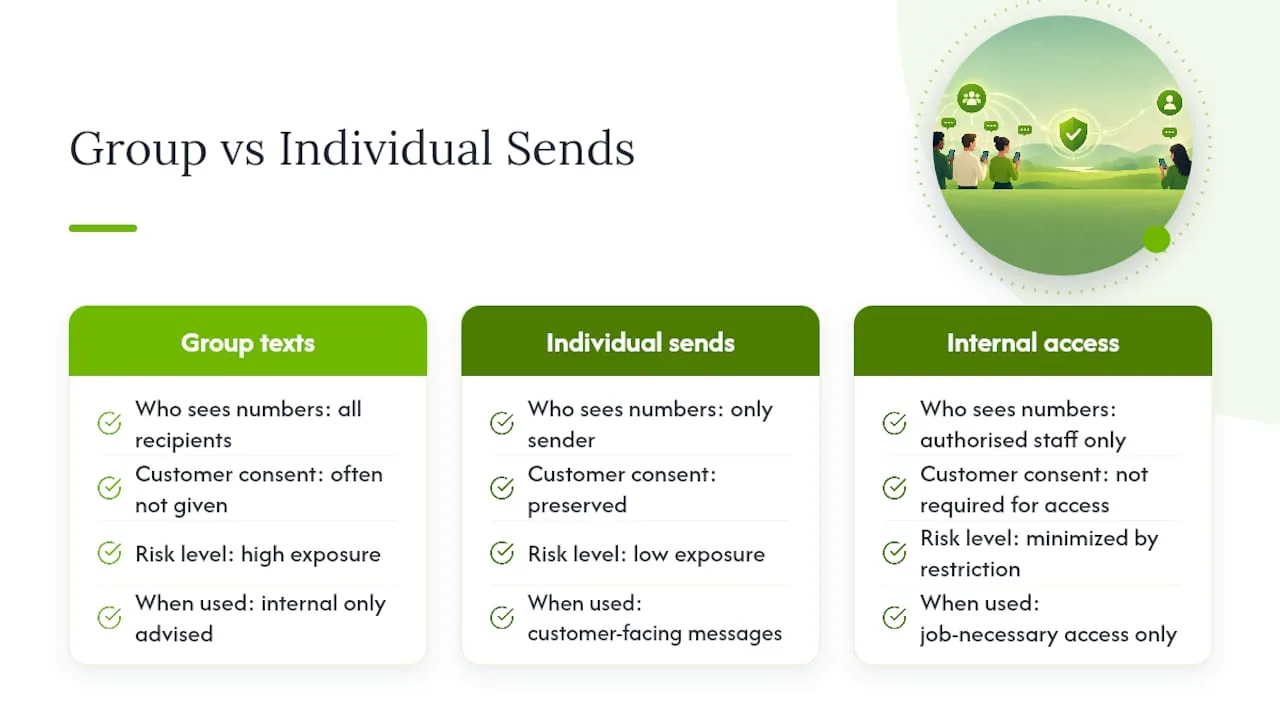
The same caution applies to sharing customer numbers internally. Limit access to whoever actually needs it to do their job, whether that's a scheduler or a support rep, and avoid forwarding customer threads into group chats or shared inboxes without a clear reason. A phone number is personal information, and treating it that casually undermines the trust a customer extended by giving it to you in the first place.
If your business texts multiple people about a shared appointment or account, like a family booking, get explicit agreement from the primary contact before adding anyone else to the thread.
9. Cultural differences in SMS etiquette
Texting norms are not universal, and a message that reads as friendly in one region can feel abrupt or overly familiar in another. Expectations around response speed, formality, and even emoji use shift depending on where your customers are and what they're used to in business communication.
In some regions, a text without a greeting or a customer's name feels cold. In others, brevity is expected and a longer message feels like it's wasting the recipient's time. Formality expectations vary too: some cultures expect a text from a business to read almost like a short letter, while others treat SMS as inherently casual regardless of who's sending it.
If your business serves customers across different regions or countries, it's worth adjusting templates rather than assuming one tone fits everyone. A simple test: ask a colleague or contact based in that region to read your draft template and flag anything that feels off before you send it broadly. Small adjustments, like adding a greeting or trimming a message down, often matter more than translating the words themselves.
10. Impact of SMS etiquette on brand reputation and customer trust
Every text you send is a small trust transaction. Send it at a reasonable hour, on a topic the customer cares about, with an easy way to opt out, and you reinforce that your business respects their time. Get any of those wrong repeatedly, and customers stop opening your messages at all, or block the number outright.
The relationship works in both directions. A well-timed appointment reminder that prevents a missed booking builds goodwill in a way that costs you nothing extra. A promotional blast sent at the wrong hour, with no easy opt-out, does the opposite: it turns a routine touchpoint into a reason to distrust the business.
Consistency matters as much as any single message. Customers form an impression of a business's professionalism from the accumulation of small interactions, and texting is often the most frequent one. A business that texts sparingly, clearly, and respectfully tends to earn faster replies and fewer complaints over time, which shows up directly in how smoothly appointments and follow-ups go.
11. Common SMS etiquette mistakes to avoid
Most texting complaints trace back to a small, repeatable set of mistakes rather than anything exotic.
- Texting before getting clear consent, or assuming a number given for one purpose covers any future use.
- Sending messages outside reasonable hours, especially early morning or late evening.
- Cramming multiple topics into one message instead of sending a focused, single-purpose text.
- Skipping the opt-out line on recurring messages, which frustrates customers and invites carrier filtering.
- Over-texting after a customer goes quiet, instead of sending one follow-up and then switching channels.
- Sharing sensitive details like payment information or medical data over SMS, where there's no reliable protection.
- Letting group texts expose customer numbers to each other instead of using individual, segmented sends.
Fixing this doesn't require new software or a lengthy policy. It requires reviewing your current templates against this list and adjusting the ones that fall short.
12. Legal implications beyond TCPA and FCC rules
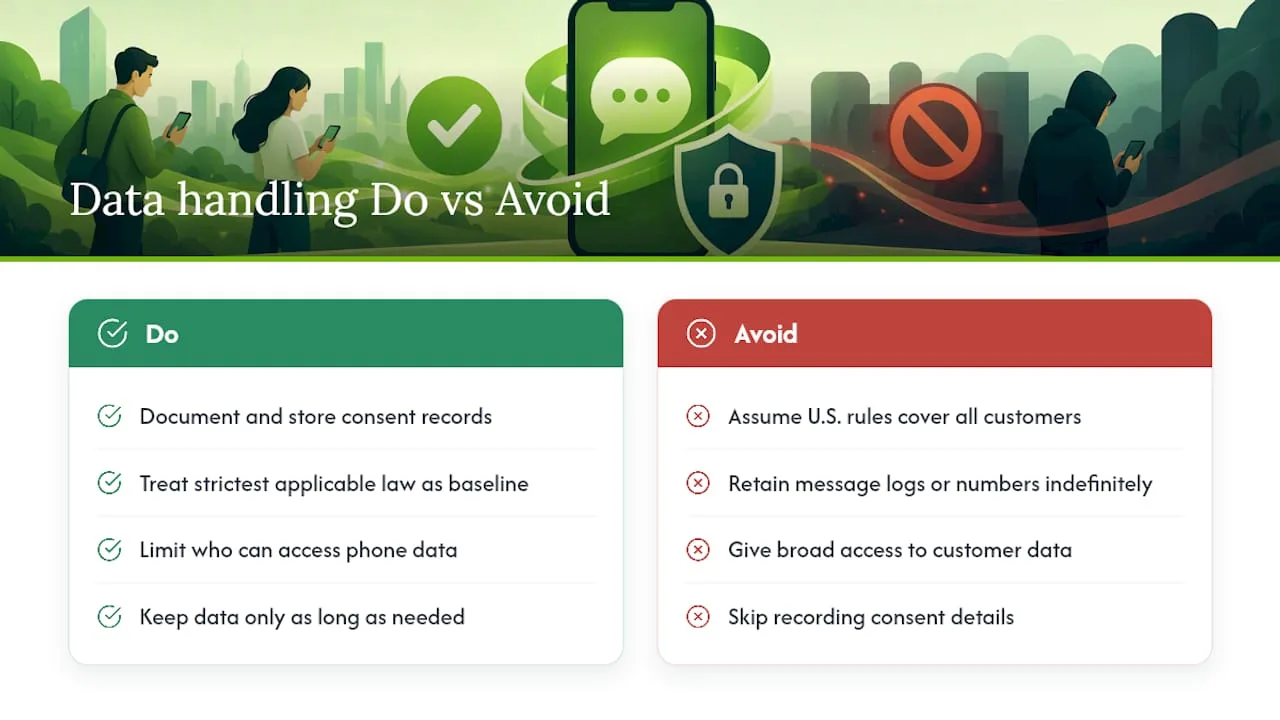
TCPA and FCC rules set the floor for texting compliance, but they aren't the only laws that apply once a business starts collecting and storing customer phone numbers. Data protection laws like the EU's GDPR treat a phone number as personal data, which means businesses operating with customers in those jurisdictions face additional obligations around consent, storage, and the right to have that data deleted on request.
Even outside jurisdictions with a dedicated data protection law, storing consent records, message logs, and customer numbers creates a general obligation to handle that information responsibly: limit who can access it, keep it only as long as you need it, and have a clear process for deleting it when a customer asks. Businesses that operate across multiple countries should treat the strictest applicable law as the baseline for their internal policy rather than assuming U.S. rules alone cover every customer they text.
None of this replaces legal advice specific to your business and the regions you serve, but the operational habits are consistent: document consent, limit data access, and be ready to explain what you collected and why.
13. Author perspective and practical tradeoffs
The businesses that get texting right aren't the ones with the longest policy document. They're the ones with three or four rules everyone actually remembers: ask first, keep it short, always leave an out. An exhaustive policy nobody reads protects nothing. A short one your whole team can recite protects everything that actually matters, and it shows up in fewer complaints and more customers who reply instead of ignoring you.
— Serhii
14. How RingPort supports compliant, templated SMS follow-up
Building and enforcing this kind of policy by hand gets harder as call volume grows, which is where automation earns its keep. RingPort works as an AI receptionist for businesses, handling calls, booking appointments, and sending SMS follow-ups with templated messaging that keeps opt-out handling consistent across conversations.
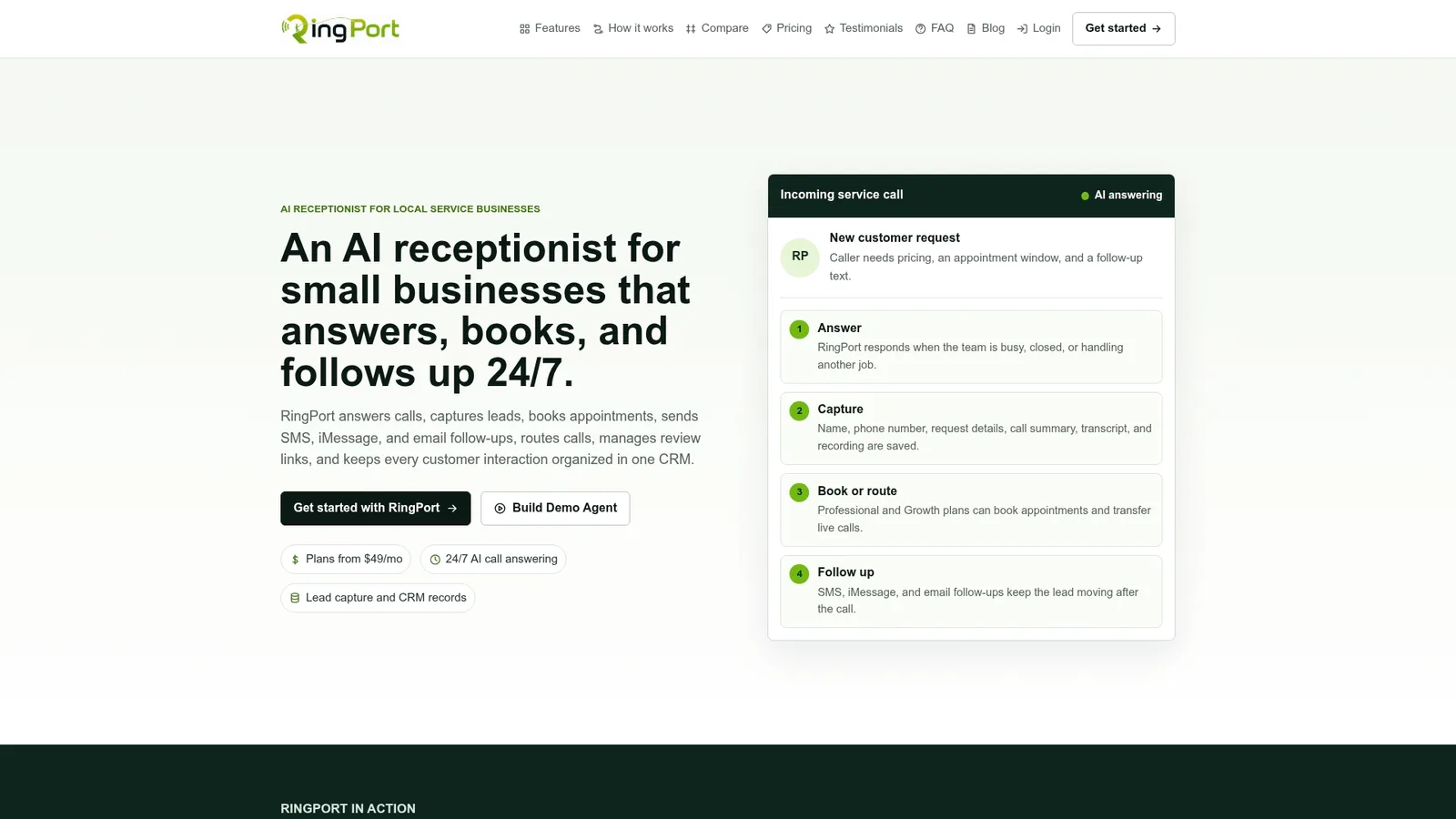
Instead of relying on someone to remember the opt-out line or the right sending hours, the templates stay consistent by design, and follow-ups route through the same system that answered the call. The RingPort Fast Agent feature applies this to templated replies and follow-up flows specifically, so a missed call or a booking request doesn't sit unanswered. If your team is still piecing texting rules together message by message, check RingPort's plans to see what running it on autopilot looks like.
15. Primary sources and further reading
- FCC and TCPA rules on consent and revocation
- CTIA messaging principles and best practices
- HubSpot's business texting best practices
- Program on Negotiation guidance on texting in professional contexts
Sources
- Business texting best practices (HubSpot)
- FCC Second Report and Order and related TCPA materials
- CTIA messaging principles and best practices
- Texting and instant messaging – Effective Business Communication
FAQ
What are some good business text messaging etiquette rules?
The core rules are to get consent before texting, identify your business in the first message, keep each text to one topic, and always include an opt-out option like "Reply STOP." Sticking within reasonable hours, generally 8 AM to 9 PM in the recipient's time zone, is also considered standard practice.
Is SMS becoming obsolete?
No, SMS remains a widely used channel for quick, transactional communication like appointment reminders and confirmations. It works best alongside phone and email rather than replacing either, since sensitive or complex topics still need a channel with more room for explanation.
What is the 3 text rule?
There's no single official "3 text rule" in the sources behind this guide, and definitions vary depending on who you ask. A common practical version limits follow-up texts after no response to one or two attempts before switching channels, rather than sending three or more unanswered messages in a row.
What is a red flag in texting?
Common red flags include texting outside reasonable hours, sending sensitive information like payment or medical details over SMS, and ignoring or delaying a STOP or HELP reply. Skipping the opt-out line on a recurring message is also a sign a business hasn't set up proper compliance practices.